Well, I suppose one should...
The World Cup looms - and disaster??? And for whom????
I shared a flat many years ago in Shepherds Bush, after making my debut in the Central London Marriage Stakes, a Listed Race for Novices. The conditions also dictated that you had to be desperate to live in Parsons Green when a three-bed flat cost £26k and marry someone who considered the whole thing a concept. The Runner-Up did not handle the ground and failed to manage the connections' expectations regarding budgets, marriage civility, and income streams, resulting in his being Pulled Up, 6 furlongs short of the winning post, and being rested for almost a decade.
During that time, he (I - in case you hadn’t guessed), rented a bedroom in a house in Shepherds Bush, owned by a chum and his very beautiful but stern blonde wife, a leading art-deco dealer. The other occupant who made up this foursome, three of whom were permanently drunk, stoned or on full leisure and pleasure mode, was Charlie. The three boys’ general demeanour did not encourage the beautiful blonde, and thus Charlie and I were told that when her two best German dealers came to London, we were never to be seen. This was on entirely reasonable grounds: Charlie and I were of a generation that remembered the 1966 World Cup AND remembered our parents telling us about fighting in the war.
The day in June 1982 came when the German dealers were arriving for a summer’s dinner, on the very same evening that Germany were playing England at around 8:00 pm - and the dealers could not have cared less!
The pub loomed as the viable alternative with perhaps some sort of Shepherd’s Bush view of 1980s food, when tragically, the other witty, engaging, savvy guests cried off at the last minute. The beautiful blonde told Charlie and me to stay to make up the numbers - but to say nothing. Inevitably, that plus ca change, ghastly moment came when the only sounds were the clash of cutlery on pottery and an appreciative “Mmmm” to pass for conversation and to indicate the food’s goodness.
I am a trooper - and when I am being fed and watered - I can be absolutely guaranteed to help, be supportive and rush to the aid. Thus, I said by way of conversation:
“Tell me, Fritz, (that was his name, and yes, I had managed to stay schtum all evening… I know!), here it is high summer, height of the tourist season, and you’re having to contend with all the dreadful crowds when all you’re trying to do is earn a crust - where on earth do you stay?”
“Oh, it’s so easy for us,” he said. “We arrive at King’s Cross, and there is a little hotel close by. It is called Poland, and we just march straight in.”
It’s quite hard to do the inverted nose-trick, where you are trying to put an entire chop through your sinus system, and I simply had to flee the table before I suffocated from the contained outburst. Charlie was two steps behind and had the wit to apologise through clenched teeth that the match had started, and we had to watch. We fell about in the sitting room, tears streaming down our faces, and turned on the television. In those days, nothing was instant, and so, as the TV warmed up, Carl arrived. As it turned out, he was charmingly concerned for our health and wanted to know what was important on TV for us to watch. We explained it was a qualifying match in football and at that moment the TV came to life to the sounds of the cast, lead and many doyens of the English theatrical establishment singing:
Oh, Oh, Oh What a Lovely War…
I think Charlie and I were, rather unfairly, in new accommodation soon after, and, what is worse, we drew 0-0 with Germany in a dull little match that left us failing to qualify for the 16 on points, without having lost a game!
The World Cup is one of those events around which entire comedy scripts and characters are constructed - think The Fast Show and the men at the bar, always agreeing with the last statement made.
In 2006, I watched England lose on penalties to Portugal, and before the game, I had a conversation with Pete in the pub. Pete had the sort of face that looked as though it had been left outside during several governments. He told me about his betting and how he had lost out on horses, wives and benefits with a consistency that bordered on professional excellence. “What do you reckon?” I asked.
“We’ll get far enough to annoy ourselves,” he said. “Then we’ll remember we’re England.”
I have remembered that ever since, and for the purposes of managing further expectations, I suggest you do too.
The Petes of this world are exceptions. They know what they fancy, they have an opinion, and regardless of experience, their expectations will always supersede them, as they have a lunge, a whack, a bung on their team.
But ask the average pub expert - “What price?” - and the bamboozlement will be total. He (most likely a He) will have opinions, feelings, hopes, memories and a flag. What he won’t have is a price. Which is unfortunate, because the moment one is forced to put a number beside a belief, an astonishing amount of nonsense evaporates.
So what is England’s price - no, don’t look at the bookies - what do YOU think it is?
The difficulty is that England exists in a strange territory where analysis and national psychotherapy have become almost inseparable. Every tournament produces the same cast of characters: the former internationals explaining that this group is different; the journalists announcing that the nation has finally learned to manage expectation; the supporters insisting they are not getting carried away while visibly getting carried away; and the broadcasters behaving as though a football competition is a cross between the Normandy landings and the Coronation.
If one ignores all of that and starts with the football itself, England are plainly one of the strongest sides in the tournament. Not necessarily the strongest, but certainly among the handful who could win it without requiring divine intervention, administrative error or a referee suffering temporary blindness. The spine is excellent: Kane remains a world-class goalscorer, Bellingham appears to improve under pressure, and Rice provides the platform upon which everything else rests. Around them, England possesses unusual depth. Saka is feared by elite opponents, Pickford has quietly become one of the country's most reliable tournament performers, and players such as Watkins, Eze, Rogers and Mainoo offer something increasingly valuable in knockout football: the ability to change a match rather than merely continue it. The lingering question is not talent but certainty. England still has one or two positions where the possibility slightly outweighs the proof. There are players who may emerge as stars of this World Cup. The very best sides tend to arrive with players who already are.
Then there is Tuchel.
I suspect the importance of management is routinely underestimated because supporters prefer discussing players. Players are tangible. One can see them. Managers are more elusive. Their influence is often inferred rather than observed. Yet tournament football is not league football. It is a series of short, violent examinations in which preparation, adaptability and decision-making matter enormously. A manager who can identify weaknesses, alter systems and make unpopular decisions without consulting a committee of journalists is worth several percentage points before a ball has been kicked.
On talent, depth and management, England scores highly. On proven elite quality, they perhaps sit a fraction behind the very best sides. On psychological resilience, the picture becomes murkier still.
England’s recent history is neither one of failure nor success. It occupies that particularly English middle ground in which a team performs well enough to encourage belief and falls short often enough to leave scars. In other words, as Pete said, we perform well enough to “annoy”. Eliminated and never lost a match - just didn’t score. The semi-finals. Finals. Quarter-finals. Penalty shoot-outs. Near misses. Honourable defeats. The national memory is cluttered with them.
The consequence is that every tournament arrives carrying a cargo of emotional baggage large enough to require its own baggage carousel. What does that mean in practical terms?
It means that if I were framing a book from scratch, weighing squad quality, experience, managerial competence, tactical flexibility, depth, fitness and morale, I would make England about 1/14 to reach the knockout stages. In truth, one would need a collapse of almost operatic proportions for them not to emerge from their group. After that, matters become more interesting.
I would make them around 4/6 to reach the quarter-finals… About 15/8 to make the semi-finals... Roughly 9/2 to reach the final. And somewhere between 15/2 to win the whole thing.
Now comes the interesting part.
Those prices feel strangely cautious to many supporters because supporters are not bookmakers. Supporters tend to think in stories. Bookmakers think in terms of risk. One imagines lifting the trophy. The other imagines balancing the ledger. Yet a price of 15/2 or 8/1 in a tournament of this size is not dismissive. Quite the opposite. It places England among the principal contenders. The trouble is that most people hear 8/1 and think outsider, whereas anyone who has spent time around racecourses knows that an 8/1 chance can be very dangerous indeed.
The betting markets, much mocked by people who have never risked their own money, arrive at remarkably similar conclusions. Depending on where one looks, England has generally traded at around 6/1 to 8/1. Which ought to give pause.
Because bookmakers are frequently accused of many things — greed, cynicism, daylight robbery and crimes against interior decoration — but they are remarkably good at aggregating information. The market absorbs injuries, form, managerial changes, public sentiment, professional opinion and vast quantities of data, then distils them into a number. Not a perfect number, but usually a sensible one. What fascinates me is not that my estimate resembles the market’s. It is that so many people find the market’s conclusion emotionally unsatisfactory.
England are not the favourites. Nor are they outsiders. They are something more irritating. They are a live chance. A team strong enough to win, yet still capable of losing. A team capable of reaching the final and capable of departing after one bad evening against elite opposition. But the real absurdity lies elsewhere. It lies in the peculiar belief that because England possesses a realistic chance of winning, it somehow ought to win.
Which is annoying.
PS: Markets I expect to see or get talked about!
Cabinet Member or Wannabe PM to suggest a permanent Public Holiday National Football day, if England wins: Starmer 6/4 - Burnham 2/1 - Rachel Reeves (I used to play for Birmingham!!!) 100/1
First Lib Dem, Green or Labour politician who declares football represents our country’s great diversity and inclusivity, and it’s not about St George.
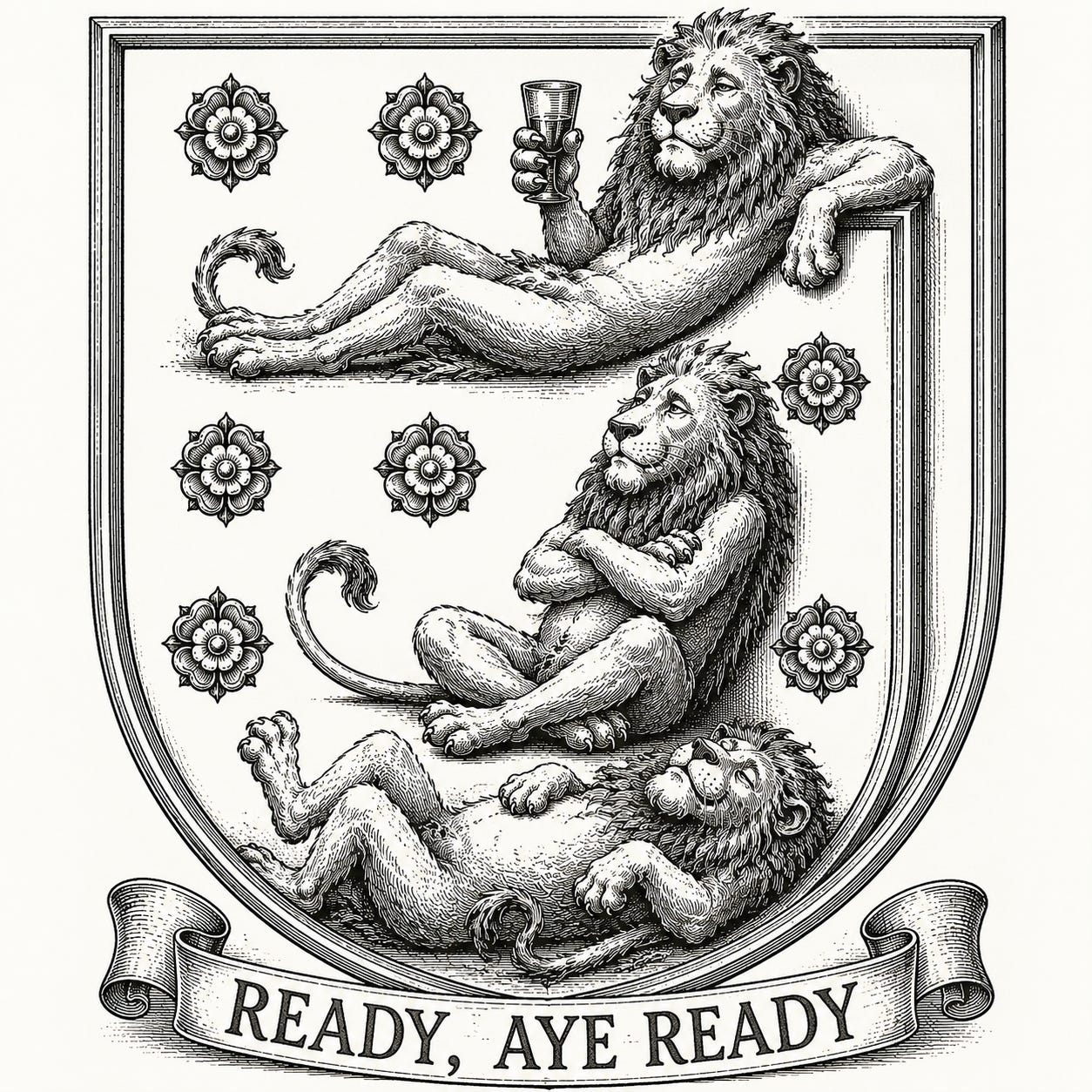
First TV historian pointing out the three lions aren’t lions at all - but historically Leopards. Lucy Worsley - David Olusoga - Mary Beard - Simon Schama - Dan Snow


