


As we come to the last three races of the 2026 Formula One season with only Las Vegas, Qatar and Abu Dhabi to go, it’s hard to say with any conviction that the FIA’s changes have finally bedded in.
Sergio Perez, for example, has been outspoken about Cadillac’s operational shortcomings, criticising poor pit stops and a car design that fails to deliver the performance he expects from a professional team. While Cadillac has retained Bottas for next season, there is a possibility that Colton Herta could replace Perez if the complaints continue.
Further along the pit lane, Mercedes technical director James Allison suggested that Kimi uses very aggressive settings to attack corner entry, helping him find time under braking. George Russell admits he is weak on hot tracks because his tyres overheat and he cannot get the balance right. Overall, it appears Kimi is drawing on his still-fresh karting memories, and it is difficult to ignore the real possibility that Toto could insist that George take a supporting role next year, despite his improving qualifying times.
George also had a run-in with Verstappen, which led the stewards to pull the Dutchman aside for a stern warning after the final practice shenanigans involving a change of direction under braking. Undeterred, Max still secured pole position even though Kimi Antonelli set the fastest qualifying time, but he carries a five‑place grid penalty. Even more irritating was that the team could have sent Antonelli and Russell out in formation for Q3, using Kimi’s slipstream to give Russell a chance at pole position. It would have cost the team nothing (Kimi already had his five‑place penalty) and would have given George another opportunity for an F1 victory. The fact that such a scenario didn’t happen rather underlines the possibility that the kid is controlling the garage.
Neither Ferrari reached Q3 in Las Vegas; Leclerc qualified 11th and Hamilton 12th. Both later benefited from Piastri’s penalty. Hamilton blamed floor damage and a major problem with electric deployment, while Leclerc was simply being Leclerc, complaining loudly about his team’s poor qualifying support. Ferrari is still trying to secure second place in the constructors’ championship, but the increasingly obvious clash between its two drivers comes at a critical point in that pursuit.
Another small headscratcher, as we fly over the Ferrari garage, is whether the myriad rumours surrounding the Brit, Oliver Bearman, who has publicly expressed disappointment that his 2027 Haas contract has yet to be finalised. Rumours that Bearman demanded a €6 million salary have been dismissed by Ayao Komatsu, the Haas team principal. The subtext suggests that Bearman’s management is already in discussions with Ferrari, and every time Lewis reminds the world that he’s 41 and still determined to race in 2030 when V8 engines are reintroduced, it makes one wonder whether Lewis might very well end up in the same position as Seb Vettel in 2020.
You might remember that Ferrari effectively sacked Seb before the 2020 season even started. He joined in 2015 and was under contract until the end of 2020. During the COVID shutdown, Ferrari announced that Vettel would leave at year’s end. Although the departure was described as a mutual decision, Vettel made clear he had not been consulted. He was replaced by Carlos Sainz, and Vettel was forced to race the entire season in a car that was effectively no longer his. There are striking similarities, and the next three races might tell us more!!!
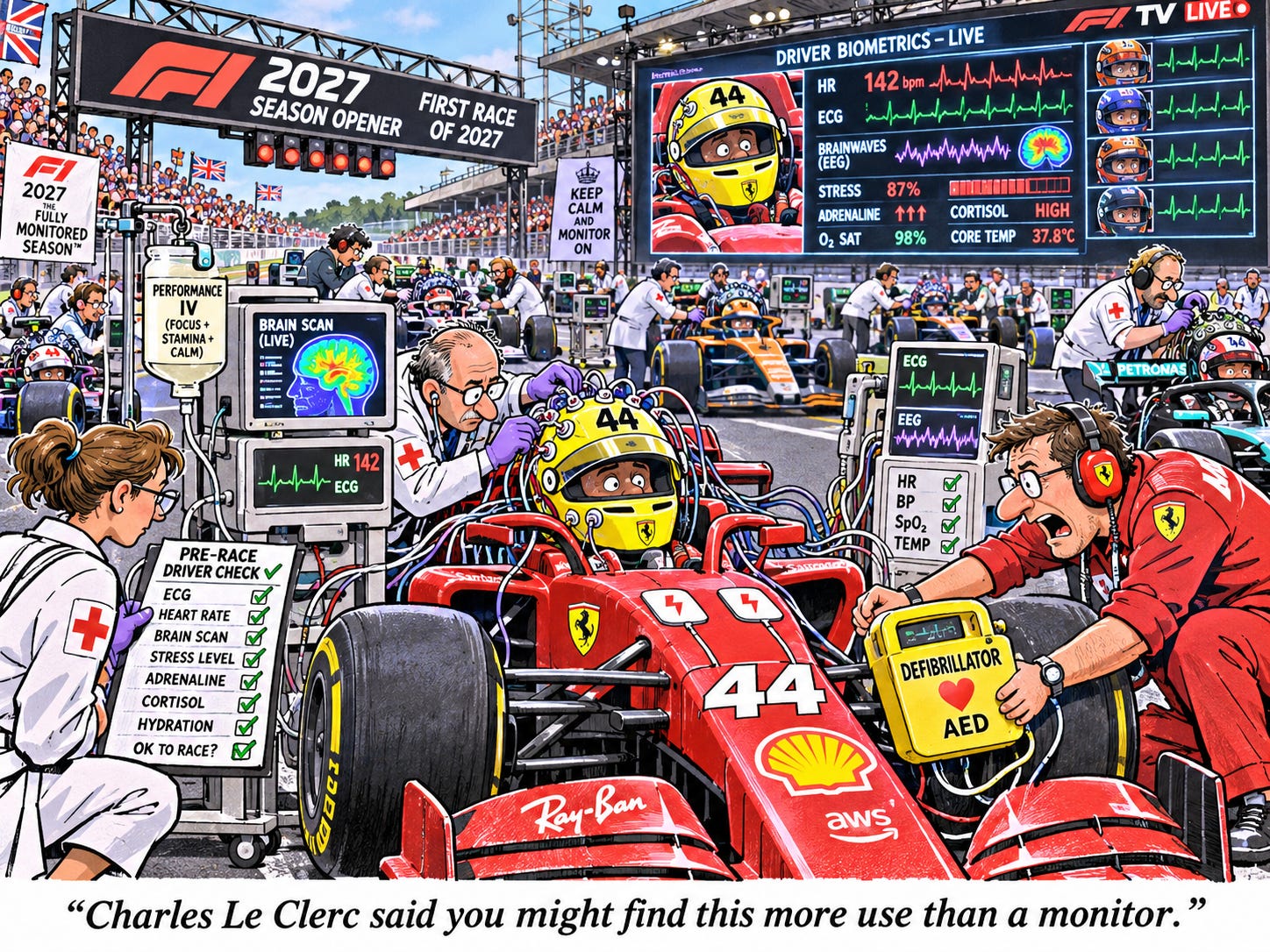
Finally, starting in 2027, F1 drivers will be wired to provide TV audiences with biometric data, such as heart rate and blood-oxygen levels. Max has objected, citing privacy concerns, while Le Clerc suggested that viewers might find it interesting to compare younger and older drivers. What can he mean?