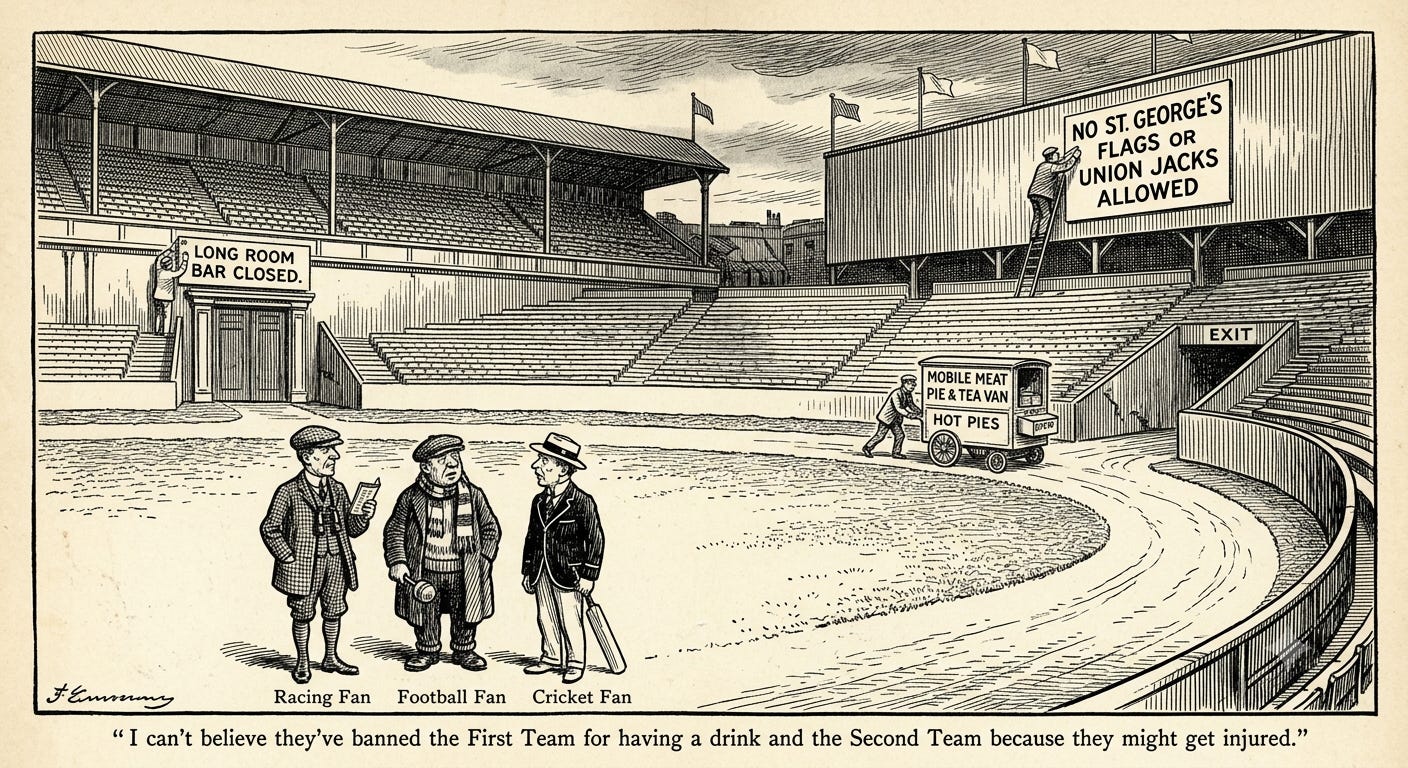
The Doctor will see you off now!
Can I just tell you straight away that you might not want to read the rest of this if you see yourself as an enthusiast, supporter or fan of English sport, because you are doomed.
You think me harsh?
Let‘s focus on Footy for two seconds then.
I saw the winner of the World Cup last night, and you can forget the Roy Of The Rovers stuff, plucky Blighty isn’t even playing the same game as France. - similar, but woefully different. Think of your six-year-old daughter, or perhaps your seven-year-old grandchild, sitting at a Bechstein, playing a duet with Lang Lang, and him being kind until he realises the time and has to finish the minute waltz in 28 seconds. The child looks startled and then starts weeping. He or she doesn’t know why, but the chasm between aspiration and ability is so overwhelming that only tears will be shed.
Tonight will be the same with Doctor Congo, as the man in the pub called them. We will win, probably, but we’re not going any further. If we win, it will be because we scraped through 2-1 or got away with it on penalties. DR Congo are not mugs: Sébastien Desabre has them in a compact 5-3-2, and they conceded only two big chances in the group stage. Their back line includes Aaron Wan-Bissaka of West Ham, Axel Tuanzebe of Burnley, and captain Chancel Mbemba, with Arthur Masuaku also giving them top-level experience. Up front, Yoane Wissa is the obvious Premier League danger: now at Newcastle, and with three of DR Congo’s four World Cup goals so far. DR Congo are defensively serious and physically awkward, with enough Premier League-grade bite to make this look like only slightly better than Tommy Cooper compared to Penn and Teller - but don’t tell me England was “magic” afterwards!
In Cricket, I defy anyone to tell me that the Ben Stokes situation is a good result for the application of 1990s-style HR, proper Health and Safety regulation and the victory of good management over foolish exuberance. Ben Stokes has something of Puck about him: a rare talent whose value lies precisely in his refusal to be ordinary. Such characters are rarely improved by committees. If I took the analogy seriously, I might suggest that Oberon understood that Puck was most effective when Oberon gave him a task and then stood back. The ECB, like so many modern sporting institutions, lacks that confidence. They have an instinct to regulate, protect and manage exceptional people until the very qualities that made them exceptional begin to disappear, as do they themselves. I’m afraid no apologies, no amount of wishing upon a star, no throwing fairy dust around is going to alter the fact that the ECB made a disastrous mistake and lost Stokes.
For some time now, I have, on an almost constant basis, been warning Cassandra-like of the imminent end of National racing, unless we start to act robustly now, or what is sometimes known in commercial circles as quickly.
That is not a word that sits comfortably with the BHA, which, when presented, for example, with perfectly sound candidates for the post of chairman, backs off for fear of upsetting the bookies or ARC or the man who lives in the JubeJube Tree at the bottom of Dingly Dell. Anything but a decision!!! Want to understand what this has brought us in terms of robust defence?
When asked directly in the Senedd whether his government would protect National Hunt racing, the First Minister, Rhun ap Iorwerth, chose not to rule out future legislation. Now, whilst that is some way short of a policy announcement, refusing to close a door is often interpreted as leaving it ajar. Sensible people in racing were concerned about the precedent set by the decision to prohibit greyhound racing. Once a government has accepted the principle that an animal sport can be banned because the welfare risks are deemed inherent rather than manageable, campaigners inevitably begin to ask whether the same reasoning should apply elsewhere. Earlier this year, Plaid Cymru Westminster leader Liz Saville-Roberts publicly called for jump racing to be outlawed in Wales, making it clear that the issue is no longer confined to animal welfare groups. That matters because Wales has three National Hunt venues, Chepstow, Ffos Las and Bangor-on-Dee; each of those supports an ecosystem of tax-paying employment, supporting trainers, breeders, stable staff, veterinary practices, farriers, transport companies, hospitality businesses and rural employment far beyond the racecourse gates. Supporters argue that any debate should weigh those economic and cultural benefits alongside welfare concerns, but if you can see any campaign underway from Slothgate HQ, you have far better eyesight than I do.
The First Minister’s silence is far more significant than any outright denial would have been.