


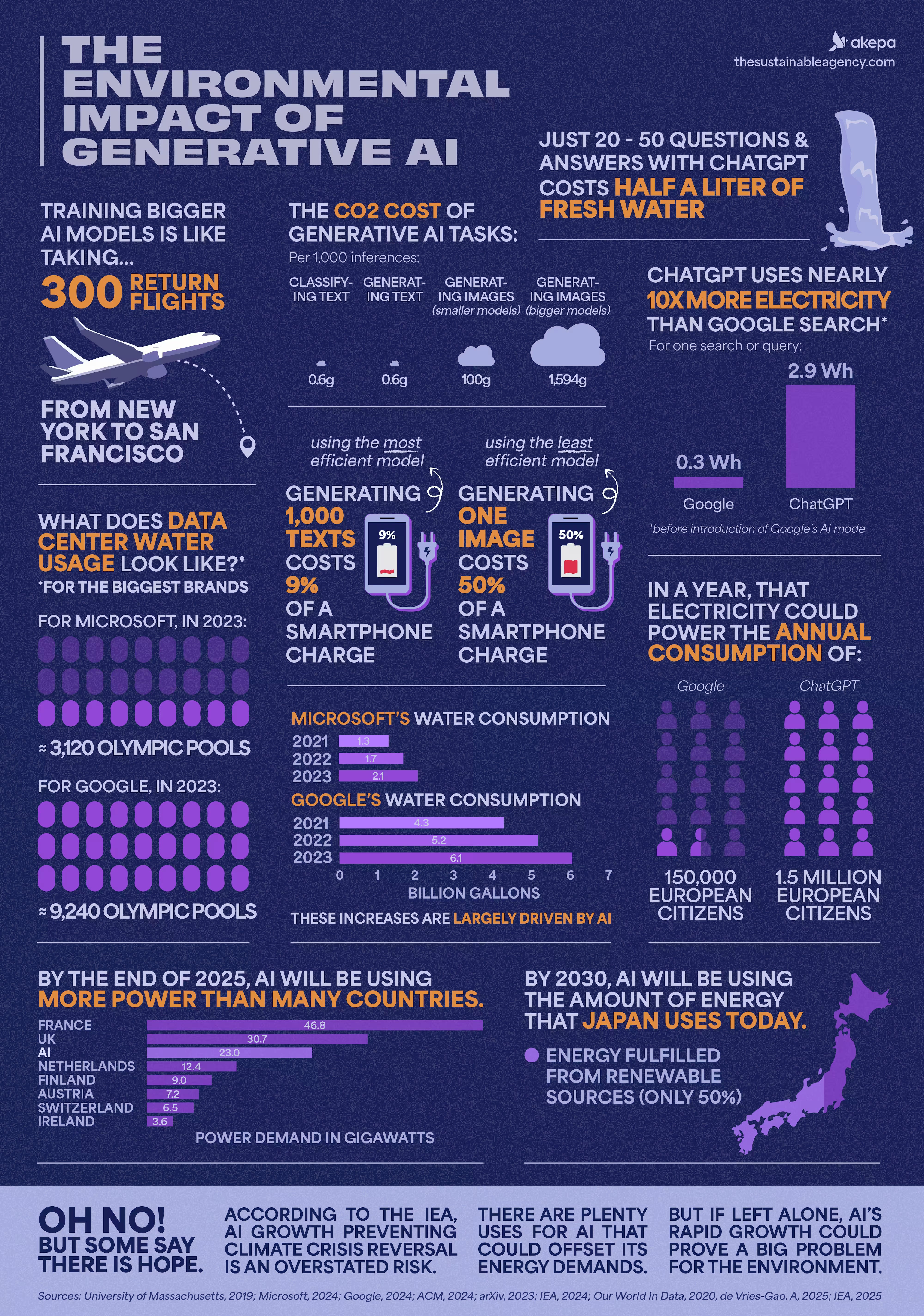
Every week, the government announces another upbeat investment, savings, job-creation, and R&D scheme that will not only save Britain’s economy but also the whole world. All these announcements focus on the miracle of Artificial Intelligence (AI) and Large Language Models (LLMs).
Simultaneously, there are harsh warnings from the financial sector, ranging from systemic market risks to operational challenges and ethical issues. There’s going to be a bubble, warns the Bank of England; the IMF warns of the overuse of AI creating market instability, correlated positions and “model herding”; International Banker warns of the over-reliance on a very limited number of system providers, potentially creating a single point of failure.
Before we hit any of those problems, of course, there is the overarching issue of HMG's involvement, which always brings with it a total failure to understand, predict, ot mitigate the possibility that the law of unintended consequences is in full effect. In fact, all these private investments and government incentives have become a giant digital wrecking ball, creating a seismic shift in the job market that’s already hitting some demographics far harder than others. It seems we’ve traded a productivity problem for a potentially nasty inequality problem. (Quite apart from the Net-Zero-You’re-Kidding-Me issues outlined above in the informative graphic!)
The crux of the matter is that AI isn’t just optimising businesses; it’s aggressively redrawing the boundaries of who gets a foot on the career ladder and who gets left waving from the ground floor. Data from 2025 has laid bare a slightly terrifying truth: as AI takes over, it’s not the seasoned old hands being shown the door; it’s the young, hopeful, entry-level workers and specific chunks of the white-collar world. The tech industry, that supposed engine of the future, is already stalling, with junior roles being halved as algorithms take over the grunt work. We’re facing an urgent policy headache, a socio-economic migraine where the promise of immense wealth rubs shoulders uncomfortably with the threat of mass job displacement.
The job market is undergoing a lightning-fast makeover, and the new beauty standards are all about skills that play nice with our silicon overlords. Those who possess the human firewall skills—critical thinking, creativity, and nuanced communication—are thriving in this augmented environment. Conversely, anyone whose job description reads like a to-do list for a sophisticated spreadsheet (think routine data entry and basic administrative tasks) is now in the high-risk category for automation. This accelerating digital transformation is creating a widening economic chasm as more companies pivot their focus from traditional hiring to pure AI innovation.
No age group is feeling the chill wind of automation quite like Generation Z, the 16-to-24-year-olds who were supposed to inherit the digital earth. Economists are calling their current plight a triple-whammy of monumental proportions. First, they were handed a post-pandemic economic slowdown that, according to one 2025 study, led to a staggering 40% reduction in entry-level job growth. Just as they were dusting themselves off, the second blow landed: a 32% drop in opportunities for new graduates, making this the worst graduate job market since 2018. The third, and arguably most brutal, hit is automation. LLMs and AI are now tackling so many routine tasks that these roles have shrunk by an estimated 35% since the launch of ChatGPT. It’s no surprise, then, that overall UK job vacancies plummeted by 43% between May 2022 and May 2025. The high-paying, but high-risk, roles are down by an even more depressing 34.2%.
The displacement of these crucial entry pathways is the true crisis. Companies most exposed to AI have cut jobs by an average of 4.5% overall, but junior roles have taken a 5.8% hit. Nearly one-third of UK entry-level jobs have vanished since 2022. The most visible casualties are in the Administrative and Clerical sector, where LLMs can now handle 26% of tasks—scheduling, drafting emails, document review—with minimal complaint and no need for a coffee break. Even the highly desirable Technical and Skilled Junior Roles, like those in software engineering and data analysis, are declining. New hires now need to immediately move from routine coding to interpreting and improving AI-generated work. The days of simple training wheels are over.
Even the Retail and Service sectors, which rely on physical and social interaction and were once considered the haven for young graduates (in 2021, almost 30% of graduates under 25 worked in low-skilled jobs), are now at risk in a slowing economy. While less exposed to generative AI, job losses are still sharp, pushing the 2025 national unemployment rate to 4.7%. About 10% of jobs in sectors with high youth employment are directly at risk from AI, and a shocking 45% of young people’s current jobs are expected to change significantly. They’re missing out on the hands-on experience that once formed the bedrock of a stable career.
While the youth are getting a raw deal, AI presents a different set of opportunities and anxieties for other age groups. The 25-49 Age Group, spanning from early to senior professionals, isn’t seeing a mass exodus; they’re experiencing a seismic shift in how they work. This cohort is the early adopter of the AI ecosystem, with 79% using generative AI in the workplace. Paralegals, for example, now use AI to blitz through legal research. This efficiency is terrific, but it comes with a nagging worry: a 2025 poll found that 62% of workers aged 25–34 are concerned about losing their jobs to the digital revolution. This anxiety is highest in white-collar fields—finance, law, and media—where up to 37% of jobs are considered at risk.
However, those in this age bracket who manage to pivot from the routine to the strategic, client-facing, or complex are reaping immense rewards. Professionals with strong prompt engineering skills—the ability to effectively boss an AI around—are seeing a 56% wage premium over their peers. The mid-career worker is in a race against time, needing to quickly upgrade their skills from ‘doing’ to ‘directing’ the AI.
Meanwhile, the 50+ Workforce is demonstrating a surprising resilience. Often occupying senior, managerial, or specialist roles that rely on judgement, established networks, and soft skills, they are largely protected from immediate replacement. Their challenge is reskilling, not replacement. Management roles, which require strategy, ethics, and people skills, have a mere 3% replacement risk. Firms most affected by AI have actually retained their senior employees while junior roles vanished. Jobs requiring regular human interaction and empathy, such as in health and social care, are expected to see the most job growth from AI in the UK over the next two decades. Perhaps this job security is why younger workers are 129% more likely than those over 65 to fear that their jobs will become obsolete. The grey-haired wisdom of experience, it seems, remains a valuable, and currently unautomatable, commodity.
The good news is that most economic forecasts predict AI will be a net job creator in the long run, with one estimate expecting a global gain of 12 million jobs by 2030, and the UK’s £16 billion productivity boost waiting in the wings. But the key challenge isn’t the total number of jobs; it’s the enormous skills mismatch between the jobs that are disappearing and the ones being created.
The survival guide for the modern worker is clear: invest in Protected Skills. These are the fundamentally human abilities AI cannot easily replicate: creative thinking, critical analysis, and nuanced communication. Management, which depends on empathy and negotiation, faces a low 8.5% automation risk. And a new, vital skill is emerging: AI-Specific Literacy—the basic knowledge, management, and ethical oversight of our latest tools.
For the under-21s, the old career paths are dissolving into thin air. Their success hinges entirely on
