
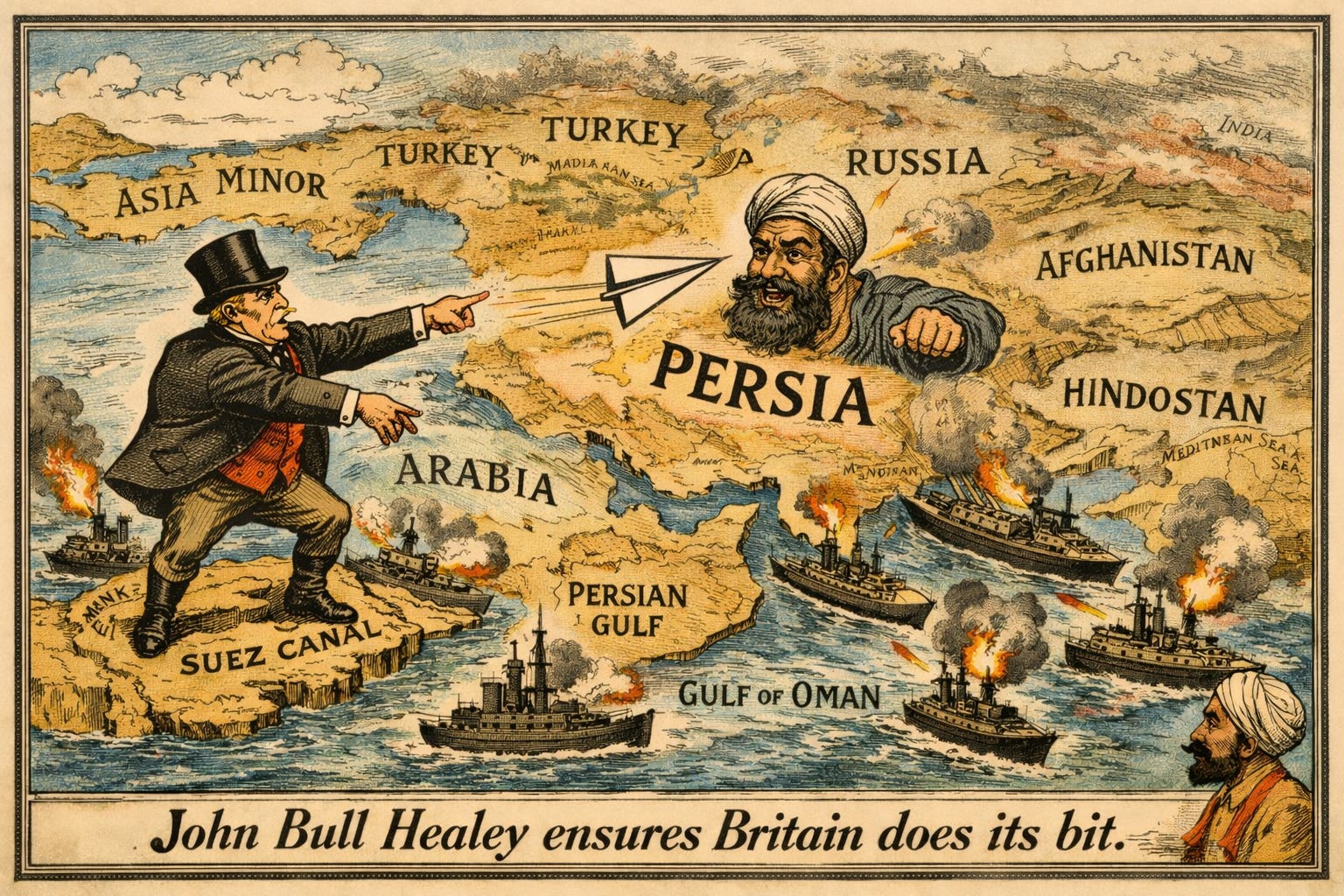
Please stop posturing - the yanks haven't declared war since 1942 - so no permission needed!
I am perplexed about whether Blighty is de facto at war with Trump, because Trump is an ally. Or are we at war with Trump because of Chagos? Certainly, the Islamic Republic of Iranian Youth Culls believes we are, and has thus launched the odd drone at Cyprus. Some colonial historians on the left might consider the UK historically and partially responsible, as the creators of that infamous double act, The Travelling Cartographers - Sykes & Picot, “A Song, A Laugh and a Map forever”.
I suspect this might well escalate beyond a drone for Cyprus, and come to our home shores, possibly thanks to our continuing open-door policy, which saw the presence of a bunch of Pro-Iranian regime flag-wavers at a protest March on Sunday attended by Jeremy Corbyn.
Thought No 1: Corbyn aside, why have we got pro-regime - and thus by definition, fundamentalist Islamic Iranians who have never been outwardly pro-Christian and are not well-known for their views on integrating into the culture of their hosts - living in this country?
Deciding Trump is a lunatic warmongerer who has illegally declared war and is acting unlike any other previous POTUS would be a mistake - and an ill-educated one at that. For almost eighty years, presidents and Congress have faced an ongoing debate about who has the authority to declare war and send troops overseas. The United States has fought in many wars without issuing formal declarations of war. The Constitution gives Congress the power to declare war, but the last time this happened was during World War II, when lawmakers declared war on Japan, Germany, Italy, and other Axis countries in 1942.
After World War II, the nature of conflicts shifted. Instead of direct wars between countries, there were more ideological standoffs and proxy wars. During the Cold War, leaders feared that formally declaring war could lead to nuclear conflict. In 1950, when North Korea invaded South Korea, President Harry Truman did not ask Congress for a declaration and instead called the U.S. response a United Nations “police action.” This set a new pattern: the U.S. could take major military action without a formal declaration of war. In contrast, the United Kingdom declared war on Argentina during the 1982 Falklands conflict; the British approach focused on formal procedures and clear political signals. This difference raises an important question: was Truman’s decision a necessary safety step, or did it weaken democratic oversight? Looking at both choices helps explain why executive flexibility became so appealing and encourages us to think about which risks and values matter most during a crisis.
Over time, presidents have taken on more control over military decisions. During the Vietnam War, Congress passed the Gulf of Tonkin Resolution rather than issuing a formal declaration. This resolution gave the president the power to take “all necessary measures” to defend U.S. forces, but Congress still wanted to retain some control over the broader war strategy. In later conflicts, such as the Gulf War, the Afghanistan War, and the Iraq War, Congress used Authorisations for the Use of Military Force (AUMFs). Each AUMF sets out specific goals or targets, trying to limit the president’s authority while avoiding the political consequences of declaring war. However, these authorisations often left considerable room for the president to decide how and where to use force.
In 1973, Congress sought to regain some control by passing the War Powers Resolution. This law requires presidents to notify Congress within 48 hours of sending troops and limits these actions to 60 days without approval. Still, the law has mostly served as a guideline rather than a strict rule. Presidents from both parties have pushed their boundaries, and most military actions still begin with the president. As efforts to limit executive power faced resistance, formal declarations of war have mostly disappeared.
At the same time, the way wars are fought has changed. Modern conflicts are often decentralised, involve coalitions, use cyber operations, or focus on counterterrorism. These changes help explain why leaders prefer flexibility over formal declarations. Declaring war carries serious legal and political consequences, signalling a level of national commitment that leaders today rarely want. Flexibility has become the standard.
Even so, the constitutional process for declaring war is still in place. If Congress declared war today, it would set off major legal changes. Several laws would take effect automatically and have wide-reaching impacts. For example, the Trading with the Enemy Act would block financial transactions with hostile countries, the Alien Enemy Act would give the government new powers over citizens of enemy nations living in the U.S., and the Selective Service Act could activate the draft. The president would also gain more wartime powers, and rules about sanctions, enemy property, and military actions under international law would change.
Internationally, a formal declaration would make it clear that the United States is at war. In today’s world of nuclear threats and complex alliances, this could raise tensions. It might also trigger automatic treaty obligations, since some U.S. allies are required by agreements to respond to a declared war, not just an authorised use of force. This is one reason why recent presidents have chosen more limited and less direct authorisations.
On an internal political basis, declaring war would require a clear vote in Congress and would likely spark intense public debate in an already divided country. For example, recent polls show that only about 30% of Americans support sending ground troops to foreign wars, and past votes to authorise military force have often exposed deep divisions by party and region. While a declaration might not change how modern military operations are carried out, since many now use drones, cyber tools, or special forces, it would change the legal rules that support these actions.
A good example of that was Geoprge Bush’s “War on Terror” which he actually called a war and given the mood of the Nation was able to sign on November 13th 2001, an Executive Order, Detention, Treatment, & Trial of Certain Non-Citizens in the War Against Terrorism, which stated that terrorist suspects will be tried before military tribunals and subjected to military detention, irrespective of whether they are captured in an armed conflict or not. From that moment, it was clear that the Administration following September 11 wanted the wartime privileges of killing without warning, detention without trial, and trials under wartime rather than peacetime rules. However, by 2005, wiser heads had recognised the strategic PR blunder of enhancing the status of Al Qaeda and other terrorists by stating it was a war, and tried to change the policy coordinates to a “global struggle against violent extremism”. The GSAVE doctrine was, however, rejected by Bush, who maintained it was a war.
Thought No 2: This is not a war, but a police action in aid of the civilian population - but it will not result in regime change; it will not result in a mass uprising; and it will result in another pan-european economic migrant crisis. So, other than destabilisation, what is the point?
One aspect I find bewildering is not simply the cost of expended munitions, but the actual availability of such munitions for the duration of Trump’s interest.
In terms of cost, for example, the 12 days of the US campaign of air and naval strikes against Houthi targets in Yemen in March 2025, codenamed Operation Rough Rider, saw Israel and the US burn through almost a quarter of the THAAD interceptors available to the Pentagon – around 150 of them, at an estimated total cost of $1 billion. At current rates, US contractors can produce around 96 THAAD interceptors per year. This means it would take at least 18 months to replenish stocks exhausted in a 12-day conflict.
This week/month, the USA is using:
• GBU-57 Massive Ordnance Penetrators (MOPs): 30,000-pound “bunker buster” bombs dropped by B-2 stealth bombers to destroy deep-underground nuclear facilities. Each one costs approx $4¼m
• Tomahawk Cruise Missiles: Launched from submarines (such as the USS Georgia) to strike missile and nuclear sites. $2m each.
• Precision Bombs and Rockets: GBU-39/B Small Diameter Bombs (SDBs) and laser-guided APKWS II rockets. Approx $40k - $100k each
• Anti-Ballistic Interceptors (Defensive): THAAD (Terminal High Altitude Area Defense) interceptors and Patriot PAC-3 missiles used to shield regional bases. THAAD $12½m - Patriot $3½m
The Iranians are using
• Ballistic Missiles (Short- and Medium-Range): Including the Khorramshahr (approx $8m), Emad, Kheibar Shekan, Ghadr-110, and Fattah-1 (hypersonic).
• Shahed Drones: One-way attack drones (such as the Shahed 136) used to swarm and breach air defences. Approx $35k each
ALL of these munitions require rare-earth supplies, as do many of the planes and rockets delivering them. The three F15s lost yesterday had over 100lbs of Samarium-cobalt (SmCo) magnets and other rare Earth minerals inside their operating gubbins. The Javelin MANPAD, F-35 fighter jet, M1 Abrams tank, and Virginia-class submarines, to name just a few high-profile platforms, are all reliant on neodymium-iron-boron (NdFeB), 87% of whose global supply comes from China. NdFeB magnets are also a critical input in drones and radar systems.
This is already causing supply chain issues. Add to that the fact that propellants such as nitrocellulose (also known as ‘guncotton’) are an essential input in the production of artillery shells and other consumer applications. Global nitrocellulose production is more diversified than many rare earths; however, China holds an outsized share of the market, again thanks to state-owned players such as Norinco Group. Since the outbreak of the Ukraine war, most of that production has been going to Russia. But all of these problems with actual supplies, availability, and slow Western production capabilities pale in comparison to the lessons being learned on the hoof, thanks to recent hostilities in Tel Aviv, (in the precursor to the current action), and the actions in Ukraine. Both theatres have shown the Armchair generals and the defence industry strategists that their modelling was wrong. Shy of the use of tactical or strategic nuclear weaponry, their thinking was that sophisticated, high-quality platforms would be the difference-maker in modern warfare. Instead, they saw a preeminently missile defence system simply overwhelmed at a huge expense by far cheaper and in almost every sense, far inferior missiles, rockets and drones, fired en masseroutinely destroying strategic industrial sites and expensive military platforms such as “iron dome” platforms.
Necessity is the mother of invention, so we can be certain that the solutions are being sought, such as BAe’s work on munition propellants - but that is some time away, I fear.
Idle Thought No 3: The productivity gap between the United States and China leads me to suspect that the USA would struggle to maintain a single long-term action, let alone the two that its military doctrines currently envisage and plan for. Imagine if China attacked Korea tomorrow. Imagine if Venezuela invited the Russians to build a base there. I suspect the tactical trade-off would be bye-bye NATO and/or Europe.
Idle Thought No 4: Dizi Abgoosht
Many years ago, I happened to be in Tehran pottering around before popping down to Khorramshahr in 1974. It was obliterated in two battles during the Iran-Iraq War, and it is hard to describe what a lovely place it was - a thriving backwater on the Shatt Al Arab River before heading to Abadan. In both places, I ate a wonderful national dish Dizi Abgoosht. Essentially, very, very slowly cooked fatty lamb in water, with lentils, chickpeas, tomatoes, onions, potatoes, herbs, and spices, where you drink the flavoursome soup first, in which you have torn up some pieces of flat bread, so nothing is wasted. Then you mash the remaining ingredients (lamb, lentils, etc.), and scoop it up with raw onions, lemon, mint, and herbs. You probably won’t believe this, but it remains the best thing I have ever eaten in a single dish. It was filling, nourishing and would keep an Irish Navvie going for a few hours - and for less (in those days) than 2/6d. One day, I shall find a Persian restaurant in London and see if they do it - if only because when I was there, I thought the Iranians charming, interesting, kind and generally amusing. The Persian Empire had produced millennia of artwork, culture, science, and food, and within a few very short years, threw it all away in some ghastly parody of a new civil order. This one dish, however, told me they couldn’t all be bad.


