

Only a proper chap has three racehorses named after him!
ID Cards are needed now.

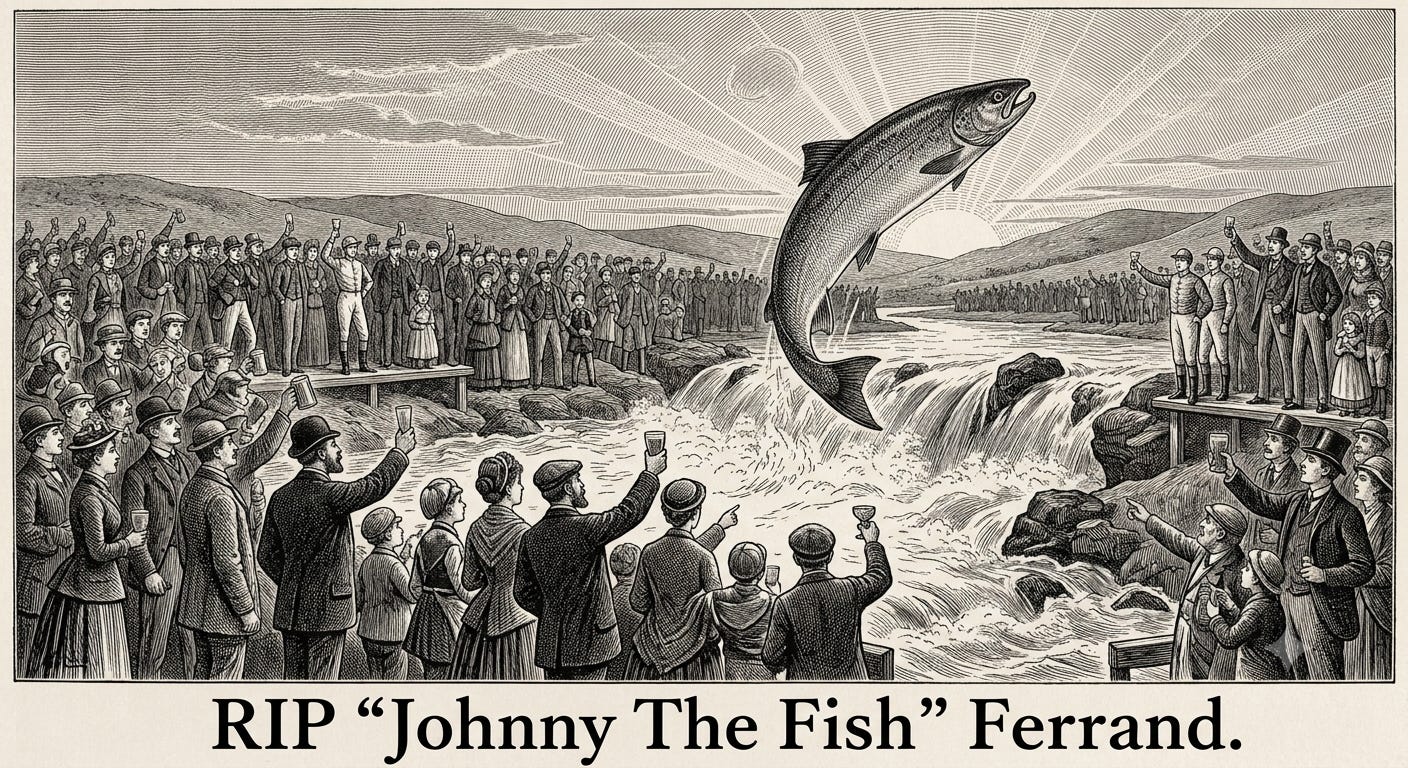
Sad news for Lambourn and the surrounds. One of its total heroes and legends, John Geoffrey Ferrand, a.k.a. “Johnny the Fish,” a.k.a. “The Ferret”, died in Reading Hospital this morning. He was an Old Harrovian who, at various times, supported the entire local pub industry by owning, looking after, or drinking in a number of the more famous pubs. He was at The Pheasant when it was co-owned by Charlie Brooks and Will Young’s dad, Robin, and the Hare and Hounds around the time that David Cecil owned it. He produced a pub guide called Fruity and the Ferret, in which Johnny The Fish was described as “… standing like The Leaning Tower of Pisa 12 hours a day”
In an interview, Johnny said, “I think that refers to the fact that I probably drink too much! I don’t get behind the bar very often. A lot of people go to their local on their own, and they want to see the landlord. They want to be welcomed, and they want to have a quick conversation. If you want to welcome those people, it’s difficult if you’re trying to serve somebody a drink at the far end. It’s easier to drink with them.”
Johnny had a simple business philosophy: “I’m aiming at the 30+ with more disposable income, which will hopefully end up in my pocket.”
A pupil at Harrow between 1963 and 1968, Ferrand went straight into the property business in London, but had an unexpected career change in 1982, when he joined a fish company, which he ran for 18 years. Hence his nickname, which was also given to a 2yo trained by Brian Meehan, which won The Leger Yearling Stakes. In fact, there were two other horses named after Johnny: John Le Poisson and Fish Called Johnny.
He was a huge friend of Nicky Henderson, who took Johnny in during Covid lockdown, and Johnny would often house-sat for Nicky. There were various rumours that Hendo had two wine cellars, one for Johnny and one for Owners, but Covid managed to undo that plan in its entirety! I wasn’t there, but when he got married (not there but still astonished), it was said that as they went up the aisle, someone muttered, “There goes Beauty and The Beast”; Johnny whipped round and said, “Please never refer to my wife like that again.”
I had lunch with him over Ascot week, and he was best described as ramshackle, but still sharp and, more importantly for a life as full as his had been, was still there.
And now he’s not, and we’re the poorer for it. God’s Rest, Johnny.
PS: I’m told that, quite brilliantly, he left an enormous tab at The Queens Arms. A fine man.
Sooner or later, I shall be proved right, and the absolute need for some sort of ID card is going to become a necessity. Everyone recognises that, for example, the NHS, the Benefits system, banking, corporate and age-specific compliance frameworks, even national security all need reform, not because they are all corrupt, but because, even petty abuse of those areas, however small, is wiping billions off departmental annual budgets.
But before everyone squeaks, many developed countries already operate systems that are conceptually similar to an ID card system, though they differ in how much they centralise information.
The key policy question is not whether to have a citizen identity system, but what powers it should and should not have. Firstly, let’s call it what it actually might be… The Citizen’s Card.
It isn’t primarily about policing; it is about proving entitlement. It should contain a biometric verification (perhaps facial recognition and fingerprint rather than relying solely on a PIN); one’s citizenship or immigration status; one's National Insurance number (or its replacement under any simplified tax system); your NHS identifier; your HMRC taxpayer reference; your driving entitlement (if applicable); your pension entitlement and your electoral registration.
It need not actually store the underlying information. It could simply hold secure cryptographic credentials allowing government systems to confirm identity.
Let’s take the NHS for example. At present the NHS often struggles to establish eligibility, especially where documentation is incomplete or multiple identities are involved. A Citizen’s Card could identify the patient immediately, retrieve their NHS record securely, confirm entitlement, reduce duplicate records, reduce prescription fraud, and improve appointment management.
It would not solve every problem, but it could improve administrative efficiency. It could become the key to claiming: everything from Universal and Pension Credit to disability benefits and housing support. Identity verification could become much quicker, while still requiring the claimant to satisfy the substantive eligibility rules.
It’s important, however, to distinguish between identity fraud and benefit eligibility. A stronger identity system can reduce fraud involving false or duplicate identities, but it does not by itself determine whether someone qualifies for a benefit.
With the Citizen’s Card, every employer could verify a candidate's right to work, their tax code, and their pension status, eliminating a vast amount of paperwork
As regards voting, I recognise that there are those that would argue the card should also satisfy voter ID requirements whilst others would argue that voting should remain independent of any wider identity system. Both views have constitutional arguments in their favour - but as a straightforward matter of being able to prove who you are with regard to the electoral register, I don't see the difficulty.
The police should only see information they are already legally entitled to obtain; and as a safeguard, every access should be logged; citizens should be able to see who has viewed their record; and any misuse should carry criminal penalties. That would make the system more accountable.
As regards privacy, I am not advocating a single central database that records every interaction with government. Each department would continue to hold its own records and only disclose information where authorised by law. The identity layer would simply authenticate the person requesting or receiving the service.
The card would therefore prove who you are, but would not automatically reveal your tax returns, your medical history, or your benefit record.
Surely it would reduce identity fraud and administrative waste, and it can make access to public services easier and reduce barriers for legitimate claimants. Critics will scream their concerns about function creep, surveillance, or concentration of state power; and supporters emphasise convenience, fraud reduction, and better public administration. Of the two, and in a country that now has £3tn in debt - I’d rather start trying to cut out any abuse of MY/OUR money!
The central constitutional principle would be that the Government should know who you are before deciding what services you are entitled to, but proving your identity does not itself grant access to your personal information. Every access must have a lawful purpose, be recorded, and be visible to the citizen. That keeps the emphasis on identity verification and service delivery while building privacy safeguards directly into the design.
If the policy objective is “prove entitlement before receiving non-emergency publicly funded services”, then a Citizen’s Card could be the mechanism for proving identity and entitlement. The key question is what happens when the card is unavailable. But this is simply a question of identifying and managing the different scenarios… surely?
Thus, in NHS terms, you might think: Accident & Emergency? Treatment first. Identity verified later. Urgent treatments - the Treatment proceeds while entitlement is checked. Routine GP appointment - Card or alternative identity verification required. Prescriptions: the Card is presented or verified digitally. This preserves the longstanding principle that emergency care is not delayed while still allowing entitlement checks for routine access.
The Citizen’s Card should verify entitlement, not create it. Parliament would still define the categories of people eligible for NHS-funded care. The card would simply provide a secure, efficient way of applying those rules consistently. Overall, the policy should be framed constitutionally rather than administratively, perhaps stating as its founding principle.:
Every person seeking publicly funded services must establish their identity and entitlement through the National Citizen Identity System.
Emergency medical treatment shall never be delayed for identity verification, but entitlement shall be determined before non-emergency publicly funded services are provided, unless Parliament has expressly created an exemption.