


“The rule is, jam tomorrow and jam yesterday—but never jam today.”
“It must come sometimes to ‘jam today,’” Alice objected.
“No, it can’t,” said the Queen. “It’s jam every other day: today isn’t any other day, you know”
― Lewis Carroll, Through the Looking-Glass and What Alice Found There
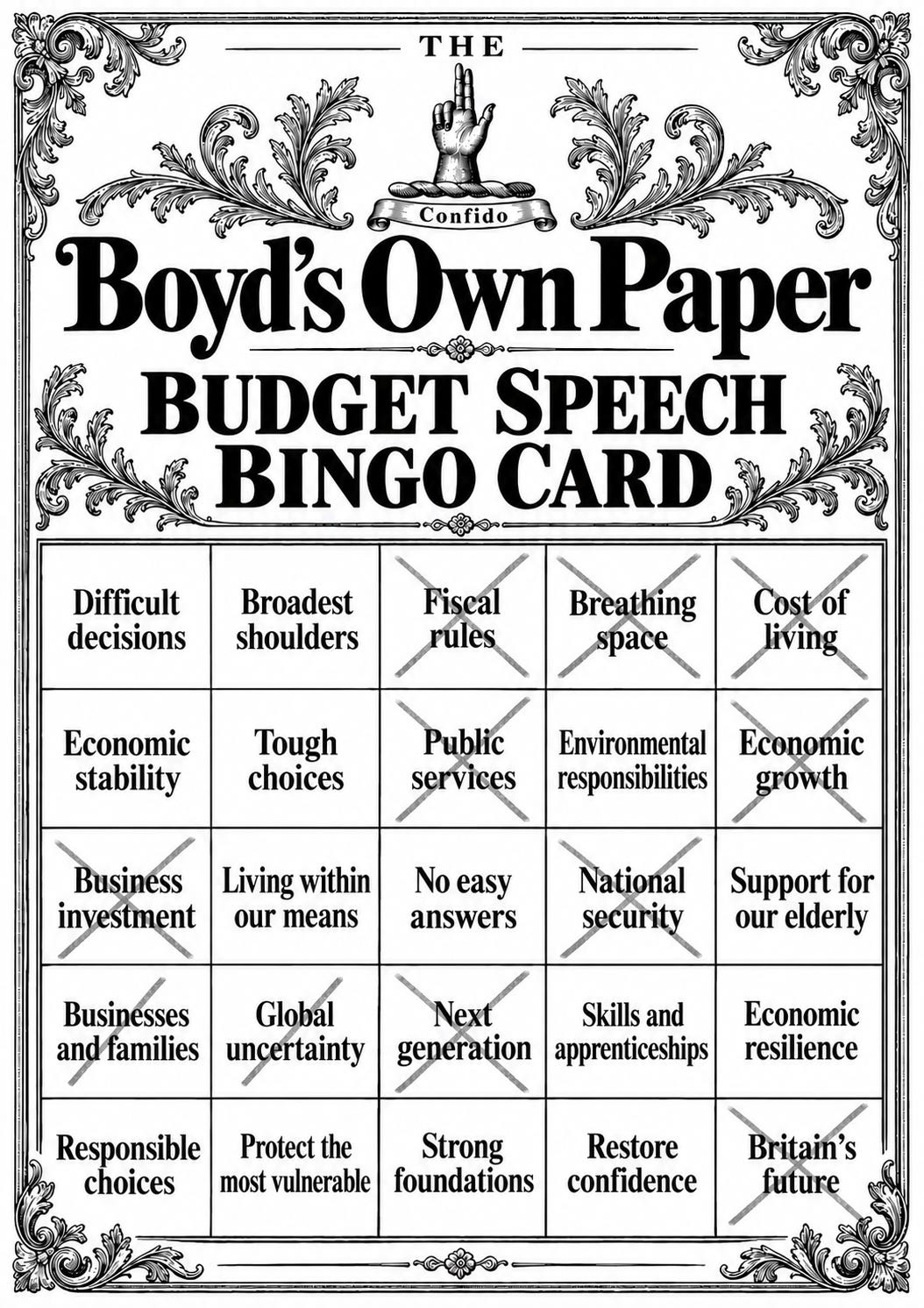
I’m not sure how many changes were announced, I lost count when it became clear that More was going to be Less. He’s adapted this, delayed that, turned the dial to simmer, given us all helmets to wear in the lowered headspace, (but charged us for them as a taxable benefit) and tiny nebulisers to help in the breathing space. Sadly, he hasn’t cut the country’s dependency on benefits, hasn’t done anything real for Defence, done nothing for protecting our borders or trimming the Civil Service, or reducing the size of the National Debt in any meaningful way. In fact, I am happy to have a small side-bet that our borrowing will be bigger than budgeted in December, than now.
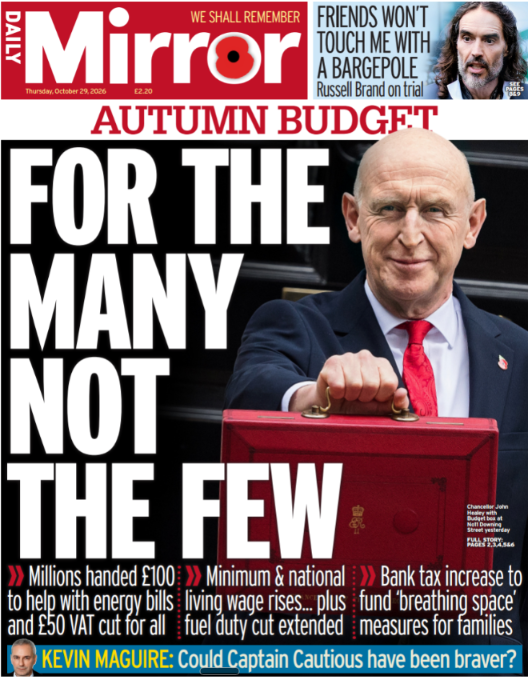
Pretty well as predicted The Torygraph leads on Healey’s announcement of an increase in income tax on property and savings from April and talks of the highest-ever tax burden. The Mirror is almost exactly as predicted: all is well in the land of the shirker/worker.
I mentioned last time out that I had asked the three main AI bodies what they thought were the twenty statements they would make as Chancellor: I am pleased to report them as follows - and with their own judgement of how they compared to the real thing. it is an interesting read.
CLAUDE:
Fiscal framework
Raise the minimum headroom against the 2029–30 current-budget rule to £30bn and keep one fiscal event a year.
Direct the Debt Management Office to shift gilt issuance away from 20–30 year maturities to cut long-end interest exposure.
Set every department a 2% annual cash-releasing efficiency target, with savings retained only when delivered.
Revenue (manifesto locks kept)
4. Align capital gains tax rates with income tax rates from 6 April 2027, with an inflation allowance for assets held over five years.
5. Replace higher- and additional-rate pension tax relief with a flat 30% rate for all contributors.
6. Abolish the personal allowance taper and lower the 45p threshold to £100,000, ending the 60% trap.
7. Confirm the January and March 2027 fuel duty rises in full, with annual RPI uprating legislated thereafter.
8. Let 0% VAT on household electricity expire on 31 March 2027, replaced by a targeted payment for means-tested benefit households.
9. Move environmental and social levies from electricity bills onto gas bills, cost-neutral to the Exchequer.
10. Raise the bank corporation tax surcharge by 2 points.
11. Fund 5,000 extra HMRC compliance staff focused on self-assessment and high-wealth individuals.
12. Raise the non-resident stamp duty surcharge from 2% to 5%.
Growth and spending
13. Abolish stamp duty on purchases of UK-listed shares to revive the London market.
14. Give every mayoral combined authority a single multi-year funding settlement from April 2027, with retained business rates growth.
15. Employer NI holiday for 12 months on hiring anyone under 25 unemployed for over six months.
16. Statutory 12-month decision deadline for nationally significant infrastructure, with deemed consent if missed.
17. Ring-fence the Defence Investment Plan within existing departmental envelopes, not new borrowing.
18. Allocate £1bn for care worker pay from April 2027 as a down payment ahead of the Casey commission.
19. Honour the triple lock in April 2027, then legislate an earnings-or-CPI double lock from April 2028.
20. Make the Youth Guarantee mandatory: under-22s on Universal Credit for 18 months must take a funded job, training or apprenticeship place.
The proposed 20-point package represents a structural shift toward radical reform (broadening tax bases, unfreezing brackets, and systematically overhauling property and wealth taxes). By contrast, the actual Budget delivered today focuses on targeted revenue raising and short-term cost-of-living relief, while maintaining fiscal drag.
HOW DID CLAUDE DO? 4/20
Key Similarities (Points of Alignment)
My 20 announcements assumed a consolidation Budget that would rebuild the fiscal buffer. Healey did the reverse: he used some of last year’s headroom to absorb the impact of the Iran war, and headroom fell to £15bn in 2029-30 from £23.6bn in March. Most of my list therefore missed, but four calls were accurate in substance:
Bank surcharge (my #10): Predicted +2 points. Actual was +3 points for a limited 15-month period.
Devolution (my #14): Predicted multi-year mayoral settlements with retained business rates. Actual went further: mayors get a slice of extra locally generated income tax plus 20% of business rates revenue.
Triple lock (my #19): Predicted replacement with a double lock. Confirmed, though later and in a different form: from 2030 the state pension rises by inflation or 2.5%, with earnings dropped.
Defence within existing envelopes (my #17): Broadly right. The existing defence investment plan is fully funded, with 3% of GDP by 2030 set as a target date.
Partly accurate in direction:
Departmental efficiency (#3): Deferred to next year’s Spending Review.
Energy levy rebalancing (#9): Took a different form. Gas standing charges will be abolished, with the cost recovered through higher gas unit rates.
HMRC compliance (#11): Delivered through new powers to collect overdue tax from those who can afford it, rather than extra staff.
Wrong outright:
Headroom: My £30bn target was the opposite of what happened.
Capital gains tax: Equalisation was rejected. Instead, the Business Asset Disposal Relief threshold was halved to £500,000.
Fuel duty and electricity VAT: I had both rising or expiring. Instead, both cuts were extended to July.
Other misses: Pension relief, the income tax taper, share stamp duty, non-resident stamp duty, youth employment, infrastructure planning and care pay did not feature.
The main revenue raisers I didn’t foresee were another 2-point rise in property and savings tax rates to 24%, 44% and 49%, VAT on online marketplaces, and extra gambling taxes.
The core misjudgement was the binding constraint. I treated bond-market credibility as the constraint; Healey treated the energy shock as the constraint and put the hard choices off to later reviews.
GEMINI
Direct Tax & Personal Finance
Unfreeze Income Tax Thresholds: Index income tax thresholds to CPI inflation to end fiscal drag and restore fairness for working households.
Standardise Pension Tax Relief: Restrict pension contribution tax relief to a flat 25% rate, boosting basic-rate savers while raising revenue from higher earners.
Equalise Capital Gains with Income Tax Rates: Align CGT rates on assets with income tax rates while introducing an indexation allowance to tax real gains only.
Extend Employers’ NICs to Unearned Income: Apply quasi-employer National Insurance to property rental income and dividends to remove tax bias against employment income.
Reform Inheritance Tax (IHT) Business/Agricultural Reliefs: Cap IHT business and agricultural property reliefs at £500,000 per estate to target family farms and small businesses rather than tax planning.
Business & Growth
Capped Business Rates via Commercial Land Value Tax: Replace commercial business rates with a modern Land Value Tax levied on commercial property owners rather than business tenants.
Expand Full Expensing to R&D and Software: Extend 100% full expensing permanently to cover intangible assets, software, and domestic R&D capital investments.
Level the E-Commerce Playing Field: Introduce a 2% online delivery charge on non-essential retail deliveries to fund high-street business rates relief.
Targeted Bank & Energy Profit Surcharges: Replace windfall taxes with a stable, predictable 3% extra surcharge on net profits above £1 billion for financial and energy sectors.
Abolish Special Carried Interest Tax Rates: End the preferential tax treatment for carried interest, taxing performance-related private equity payouts fully as income.
Housing & Property
Abolish Stamp Duty for Primary Residences: Replace Stamp Duty Land Tax (SDLT) on primary homes with a progressive Annual Property Tax on properties valued over £2 million.
Introduce a Council Tax High-Value Band: Add three new Council Tax bands (G1, H1, I) on top-tier residential properties pending a comprehensive national revaluation.
National Empty Homes Levy: Impose a triple-rate council tax premium on properties left vacant for more than six months without a valid development exemption.
Green Growth & Infrastructure
Unfreeze and Index Fuel Duty: End the temporary 5p fuel duty cut and index duty rates annually to inflation, returning revenues to regional transport funds.
Targeted EV Road Usage Charge: Introduce a distance-based 2p/mile charge for Electric Vehicles (EVs) to compensate for long-term decline in fuel duty receipts while keeping EVs cheaper than petrol.
Green Transition Infrastructure Bonds: Launch sovereign-backed National Green Bonds with tax-free yields for retail investors to fund domestic grid expansions.
Public Services & Reform
Establish a Dedicated NHS Digital Efficiency Fund: Ring-fence £3 billion annually from tax-gap enforcement strictly for NHS AI adoption, administrative automation, and operational technology.
Reform Disability Benefit (PIP) Work Incentive Integration: Restructure PIP rules to allow claimants to retain benefits for 12 months after entering employment without triggering automatic re-assessments.
HMRC Compliance Acceleration Package: Invest £800 million directly into HMRC digital enforcement and staffing to close the £36 billion annual tax gap.
Re-index Public Sector Procurement Thresholds: Mandate a “UK First / SME First” evaluation weight of 25% across all public procurement tenders under £5 million.
HOW DID GEMINI DO? 4/20
Key Similarities (Points of Alignment)
High-Value Property Surcharges: The actual Budget introduced a High-Value Council Tax Surcharge starting April 2028 on properties over £2m (ranging from £2,500 to £7,500), aligning with Proposal #12.
Bank Profit Surcharges: The Treasury raised the Bank Corporation Tax Surcharge temporarily from 3% to 6%, echoing the strategy in Proposal #9.
HMRC Enforcement: Both plans mandate substantial extra funding for HMRC digital enforcement to shrink the tax gap (Proposal #19).
Targeted EV Support: The Chancellor targeted EV affordability by lowering taxes on public EV charging rather than raising EV road taxes immediately (Proposal #15).
CHATGPT
Fund permanent spending permanently: Match every additional recurring commitment with an identified recurring revenue source or spending reduction.
Publish deliverable spending plans: Replace assumed future departmental squeezes with explicit settlements that ministers commit to implementing.
Retain a fiscal contingency: Set aside an OBR-assessed buffer against adverse interest-rate, inflation and growth outcomes.
Avoid an immediate fiscal squeeze: Phase deficit reduction over several years rather than imposing a large additional contraction next April.
Reject broad stimulus: Introduce no unfunded general tax cuts, universal energy subsidies or indiscriminate business bailouts.
Use broad revenue sources: If additional permanent revenue is necessary, prefer a modest, broad-based tax increase to numerous unpredictable sectoral levies.
Stabilise business taxation: Publish a three-year corporation-tax and investment-allowance schedule, with changes restricted to scheduled fiscal events.
Protect productive investment: Preserve independently appraised infrastructure spending by making lower-return projects the first candidates for cancellation.
Support vulnerable households temporarily: Provide capped, means-tested energy assistance with an automatic expiry and an explicit funding source.
Preserve work incentives: Design temporary assistance to taper gradually, avoiding abrupt losses of support when earnings rise.
Ease viable firms’ refinancing: Expand priced, partial loan guarantees through the British Business Bank, retaining meaningful lender exposure to losses.
Accelerate business payments: Require central government to settle undisputed invoices promptly and publish compliance, releasing cash without creating a subsidy.
Reduce energy exposure: Redirect existing capital allocations towards competitively selected projects that demonstrably reduce imported-energy dependence.
Unblock electricity connections: Fund additional technical capacity to accelerate connections for ready-to-build projects, subject to regulator oversight.
Finance maintenance first: Prioritise repairs to economically important existing infrastructure where appraisal shows higher returns than new construction.
Improve debt-market liquidity: Commission the Debt Management Office to implement a transparent, market-tested issuance and buyback programme within its financing remit.
Disclose contingent liabilities: Publish a consolidated register and stress assessment of government guarantees, indemnities and public-private financing commitments.
Strengthen financial supervision: Provide resources for regulators to improve monitoring of private credit, leverage and liquidity mismatches, while preserving their independence.
Prepare for market disruption: Fund joint Treasury, regulator and industry exercises covering collateral calls, institutional failure and interruption of core financial services.
Protect financial infrastructure: Establish a time-limited, matched-funding programme for independently verified cyber-resilience improvements at critical financial-service providers.
The three differences that matter most are:
Relief is broader than I proposed. The £100 payment and extended electricity VAT reduction offer immediate assistance, but council-tax bands are an imperfect guide to financial need. My preference would concentrate more support on households least able to absorb the shock. The temporary bank surcharge rises from 3% to 6% to help finance assistance. Treasury details
Fiscal credibility remains conditional. The OBR estimates only a 56% probability of meeting the current-budget rule. That is not a crash probability; it shows how easily forecast changes could consume the remaining margin. Its assessment also describes the package’s overall fiscal scale as relatively small. OBR assessment
Delivery extends beyond your April deadline. Some relief starts before April, but major energy, investment and public-service changes run over several years. An announced programme is not the same as operational improvement by April 2027. Budget timetable and measures
My judgement: this is closer to the cushioning Budget I advocated than to a destabilising fiscal gamble. Its weakness is the reliance on future delivery and later consolidation. It should ease some immediate pressures, but today’s statement alone does not establish a stronger growth trajectory—or materially resolve the global financial risks we discussed.
It was weak, it was unhelpful, it will do more harm than good in the long-run, and it marks the beginning of a long battle and much divisive misery with a General Election within a year, two major fights between the Three Es; Environment, Energy and Exchequer and a reawakening of the entire In/Out EU problem.
Where is Private Frasier?