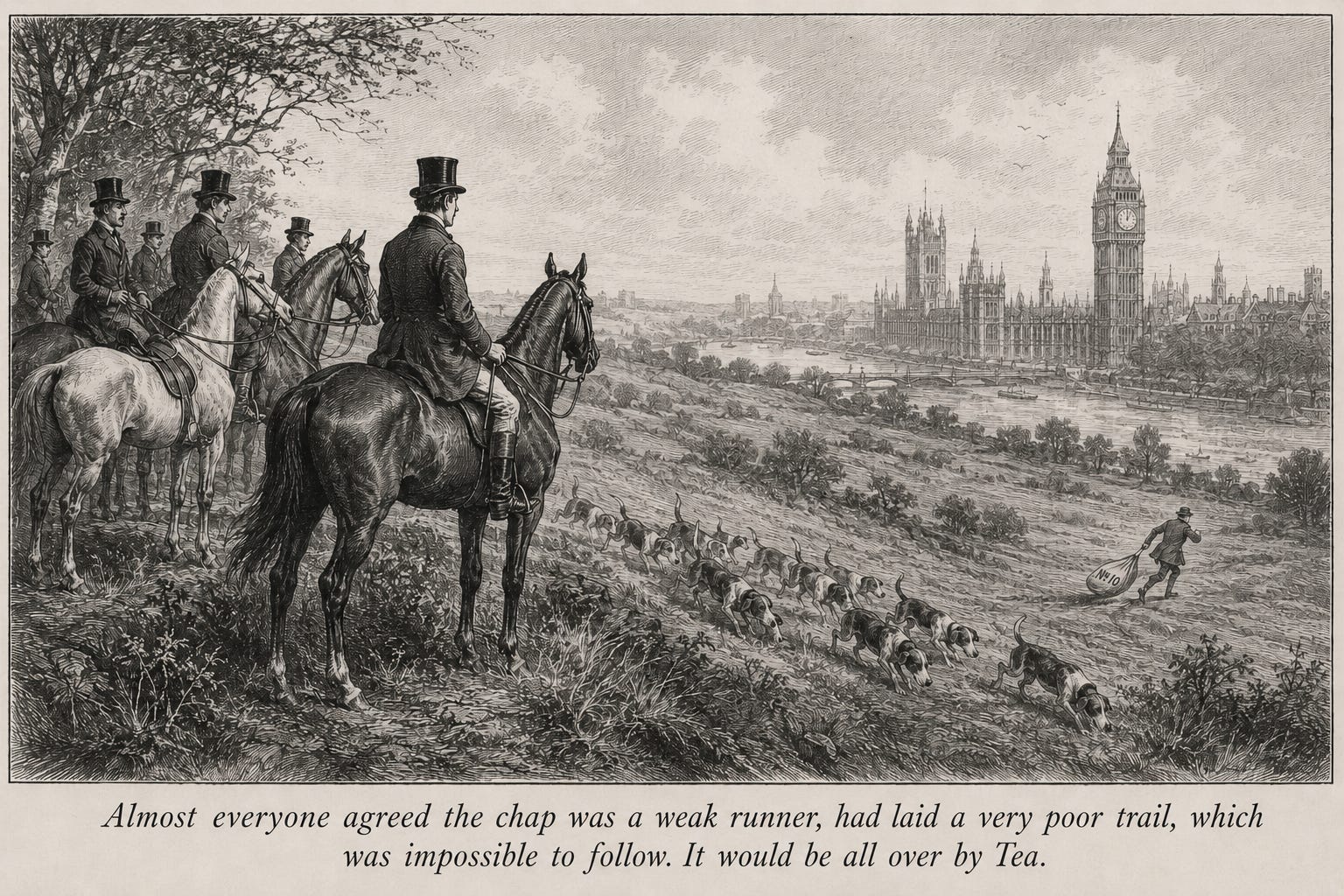
If operating without a Social Licence is bad for Trail Hunting, why is it OK for the next PM?
We're entitled to a vote - because none of us gave a mandate for what's coming
Having suggested yesterday that we are in no danger of becoming a dystopian approximation of the already-dystopian Weimar Republic, Gilts immediately headed towards 6%; Starmer said no, and every studio discussion sounded like an announcement from Suez.
Every chattering voice on the always-on-in-times-of-crisis radio keeps using variations on a theme involving Party, Nation, Electors. “… for the good of the nation and the party - it’s why we were elected…” or “… has to consider what is right for the country and the party and to honour the wishes of the electorate.”
Inevitably, at these moments, one can’t help but wonder why we’re in this constitutional stew, whether there is a possible solution, and if there is, why we have never adopted it. The answer, of course, lies with an intellectual Irishman - a persona so often at the heart of British troubles!
Enter Stage Left, Edmund Burke. Born in Dublin in 1729 to a Protestant solicitor father and a Catholic mother, Burke occupied from the outset that peculiarly Anglo-Irish position of simultaneously belonging to the establishment and standing faintly outside it. He was educated at Trinity College Dublin, drifted toward London, flirted with literature, journalism, and philosophy, and eventually found his way into politics as an intellectual operator, which, in the absence of TV, radio, and the Interweb, meant that if you could write well, you could quickly get an audience. He combined political theory, aesthetics, history, philosophy, and that increasingly endangered ability to think in complete paragraphs.
Edmund Burke developed his theories in a world where communication travelled slowly, electorates were limited, information ecosystems were fragmented naturally, and MPs exercised a degree of independent judgement because, in the 18th century, most voters (don’t forget how few actually were allowed to vote) had no way to monitor their MP, no daily news cycle, no means of coordinating opinion at scale. Mediation wasn’t a philosophical choice — it was a necessity born of distance, illiteracy, slow communication, and limited franchise. Burke was essentially codifying the only system that could exist… at the time.
Burke’s famous argument — that an MP owes his constituents not merely his industry but his judgement — rested upon a world in which representation in Parliament was not conceived as a rolling emotional plebiscite. It was a deliberative institution composed of people expected to think, compromise, negotiate and occasionally resist public passions.
In Burke’s time, of course, political identities were less rigid, information moved slowly, and party structures were comparatively loose. The average voter was not being algorithmically bombarded twenty-four hours a day by emotionally manipulative political messaging carefully designed by communications consultants with behavioural psychology dashboards open on a second monitor.
But in the endless whir of automated cameras and hundreds of international hacks standing in Downing Street, and the feeling that once again our country is being mocked, aren’t you beginning to suspect that the constitutional furniture no longer quite matches the room in which it sits?
We continue solemnly invoking parliamentary conventions, Burkean theories of representative judgement and the majestic ambiguities of the unwritten constitution, while the actual political environment has mutated into something Edmund Burke would probably have regarded -and possibly correctly - as deeply, catastrophically dangerous, a nervous collapse by the State.
Once again, we are hearing the siren call of constitutional reform being bandied about, mostly by very ordinary politicians, and normally concerning Proportional Representation. PR is a ghastly and incorrect phrase because it is a bit like calling an Octopus a mollusc - correct in fact, but pointless in description. PR has at least five different manifestations, and all of them result in schism, immobility, and a depth of political ordinariness that defies the laws of motion. For the moment, put that voting reform from your mind - but consider this.
If every time an MP crossed the floor, was sacked or lost the whip, there was a by-election called, or if every time a PM was sacked, swapped or discarded, there had to be a General Election, do you think that the local constituency or the nation would believe that they, the voters, had a hand in the process, rather than some faceless room full of people you never heard of deciding that there would be a second ballot on the third day when Crab was on the menu? Of course they would.
Might it also be possible that this constitutional change, which provided the voters with a mandate for change, might increase trust in the process, and thus, there would be far fewer cases of such behaviour?
The traditional arguments against such reforms are familiar enough. Britain, we are told, elects Parliaments rather than Prime Ministers. MPs are representatives rather than delegates. Members are elected as individuals exercising judgment rather than merely as branded voting units under party control. The Westminster system depends upon flexibility, continuity and the capacity to change leadership without permanently plunging the nation into constitutional melodrama. What tosh, and only reasonable, if one were trapped in a space-time continuum between 1780 and 1951.
We do not inhabit that world any longer.
Elections are no longer principally contests between local representatives. They are nationalised, presidentialised and increasingly tribalised media events revolving around the buzz-words of leaders, branding, emotional affiliation, culture-war identity, targeted messaging, and manipulative digital architectures.
The average British voter is not selecting The Honourable Member for Dun Scratching to use his prudent judgement on tariff reform. They’re voting for him or her because she is pretty, or he looks sensitive, and they are the Monster Raving Who Cares party. They don't tell reporters I voted for him; they say I voted Labour.
They are voting for party identity, leader image, manifesto package, tribal affiliation, and an emotional narrative about the country itself. Think that through… tell me I’m wrong about Starmer, or Maggie’s second election, or Blair’s.
Modern political parties now possess communication capabilities unimaginable even twenty years ago. Electorates are no longer addressed as coherent national publics. They are segmented into increasingly granular psychological tribes that receive carefully tailored narratives calibrated to emotional susceptibilities, fears, and cultural instincts. Different voters effectively inhabit different political realities. They’re buying the data we keep pretending we’re protecting.
One scarcely needs full-blown conspiracy theories to recognise that modern electoral politics increasingly resembles industrial-scale behavioural management. And yet Westminster still behaves procedurally as though MPs were independent eighteenth-century gentlemen riding back from Westminster on horseback, carrying considered reflections for the good people of Bristol. They are not. They are merely components within heavily branded political machines.
This is why public anger over defections, whip removals and leadership substitutions has intensified. Voters instinctively understand something the constitutional establishment remains reluctant to admit - the democratic contract has changed.
When an MP elected as Conservative defects to Labour, or vice versa, the electorate no longer experiences this as an honourable member exercising independent conscience.” They see it as “the political product I purchased has been altered after delivery.” That may sound vulgar, but modern politics itself invited the commercialisation of democratic identity. Having transformed politics into a highly sophisticated form of emotional mass marketing, they cannot then retreat behind Burkean theory the moment voters, in Amazon fashion, demand the right to return the goods.
Similarly, when MPs lose the whip, the public increasingly sees the constitutional absurdity of individuals continuing indefinitely under labels and affiliations which no longer exist in practical terms. The old parliamentary ambiguities made more sense when parties themselves were looser coalitions and MPs possessed greater independent standing. In the modern environment, party affiliation is central to electoral legitimacy. Most constituencies vote overwhelmingly along party lines rather than on personal familiarity with the local member. The electorate understands this perfectly well, even if constitutional theorists sometimes pretend otherwise.
But this argument becomes stronger still in relation to Prime Ministers.
For generations, the British establishment maintained the fiction that voters do not really elect Prime Ministers. Formally, this remains true. Functionally, it is nonsense. Modern General Elections revolve overwhelmingly around party leaders. Televised debates, media strategies, campaign messaging and political branding all reinforce presidential politics while simultaneously denying its constitutional implications. Surely you realised this when you watched - and some of you participated in - the sequence from Boris Johnson to Liz Truss to Rishi Sunak, which brutally exposed this contradiction. Profound changes in governing style, economic policy and political mandate occurred without any direct electoral endorsement. This wasn’t parliamentary democracy in action; it was a private members’ club, replacing The Chairman while the country waited outside in the rain.
The constitutional defence that the governing party retained Commons confidence is simply tosh because the voters no longer perceive parliamentary arithmetic as the only source of legitimacy; it must also involve a social licence within a media-saturated democratic culture. And media saturation changes everything.
Darling old Burke’s model and the world in which he lived gave everyone time for the shock waves from news of a plague, or a result from Waterloo, a Krakatoa, a Napoleonic victory, to be absorbed. That time cushion has been replaced by equipment in everyone’s hand, which instead generates permanent emotional acceleration. Bursts of outrage emerge hourly. Sobbing victims’ narratives mutate continuously within seconds of whatever atrocity.
AI-assisted political messaging will only intensify this phenomenon by enabling increasingly personalised persuasion at scale. We are nano-seconds away from an environment in which political actors will have the capacity to micro-target millions of voters with individually calibrated emotional narratives shaped by predictive behavioural modelling. At that point, holding onto Burke’s assumptions about representation becomes not merely outdated but structurally naïve.
The constitutional forms and the political reality have diverged too far, and on this point, Burke and I share the same track. As Burkes suggested, public opinion is volatile, often emotional, and frequently uninformed about the technical details that good lawmaking requires. A parliament that just mirrors the crowd isn’t deliberating — it’s just ratifying whatever mood happens to be dominant that week. You lose the very thing representative institutions were designed to provide.
Which is precisely why public legitimacy now requires clearer points of democratic renewal.
Automatic by-elections following major shifts in allegiance would acknowledge political reality. If MPs genuinely believe their constituents support the new alignment, they should have little fear of seeking renewed endorsement. Similarly, if a Prime Minister falls or is replaced amid a substantial political rupture, the electorate should be consulted directly rather than treated as passive spectators as internal party mechanisms rearrange national leadership.
Critics warn that this would increase instability. Perhaps they can’t count - but I would call seven Prime Ministers in ten years slightly unstable! What those nay-sayers are actually doing on each occasion is masking a legitimacy crisis as procedural continuity.
More and more, you hear people saying they don’t care, that their vote doesn’t make a difference. In effect, they’re democratically exhausted, and many are even institutionally cynical, with a growing belief that electoral mandates are simply convenient statements, to be forgotten after the Downing Street… “… and now we must get to work to build our great nation, together” Blah blah..
My fear is not the ludicrous maintenance of these clearly broken constitutional mechanics, but the decay of legitimacy and trust in a heavily manipulated democracy, which has to be changed