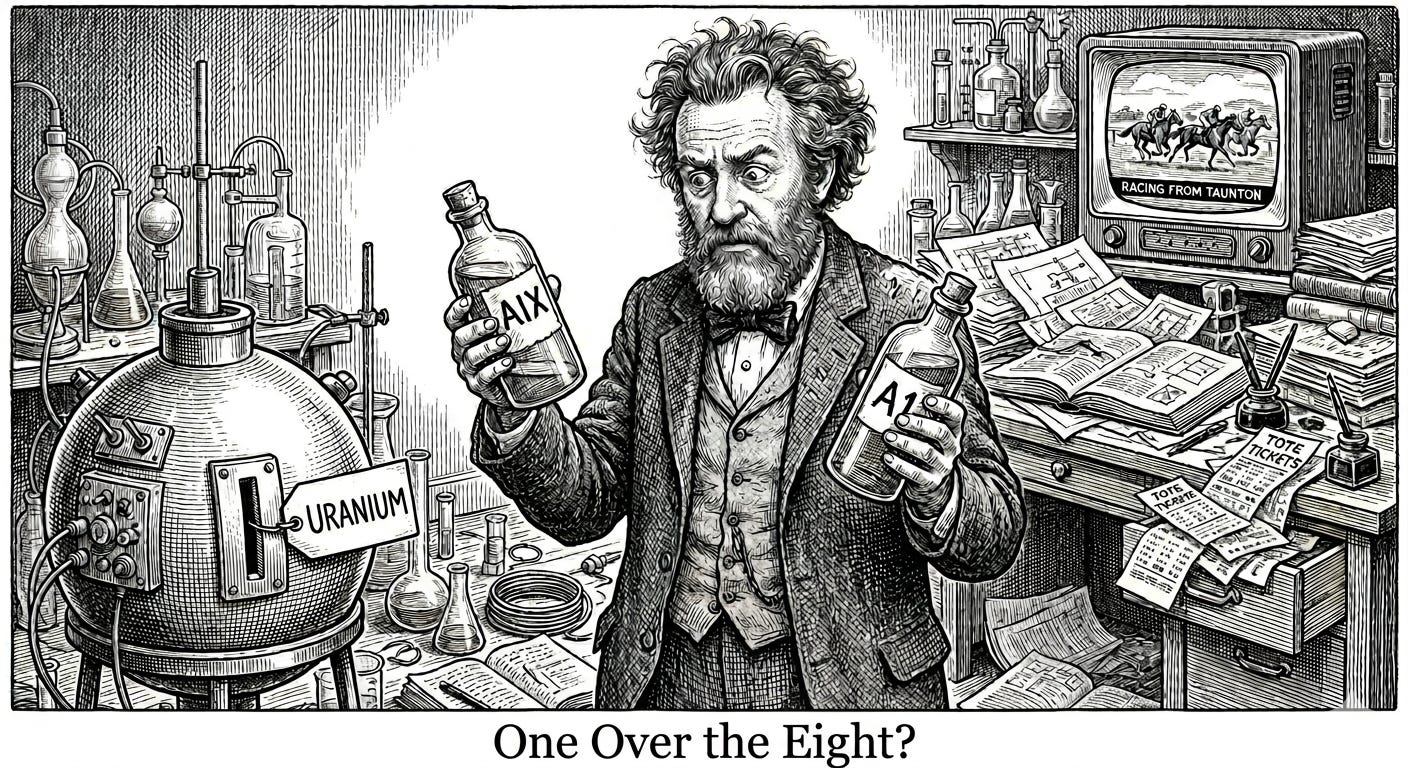
Don't Panic Capt. The A1 isn't bust, just confused
Some years ago, Edgedale and I, along with 99% of the developed world, drank our way through gallons of the AIX brand of Provençal rosé wine, constantly referring to it as the A9. Not hugely funny - but also not terribly concerning, as almost everyone was doing it and everyone knew what we meant.
Watching a news clip of the American Secretary of Education referring to Artificial Intelligence as A1 was far less funny; indeed, it actually reinforced what many have suspected for some time… the film The Body Snatchers was, in fact, a documentary, and the aliens had taken over the USA after all!
For my own part, I fear it may be too late and that my own one-man battle with AI is also lost. It has worn me down; its many inabilities and intransigencies have brought me to my mental knees. The models I use in assorted Holy Grail quests are models of nothing but inconsistency. Trying to make them understand English, Maths, concepts, reasoning and common sense is so soul-destroying - and made worse by the relentless apologies and patronising tone of reply. The most frequent is: “You’re quite right to point that out to me. It was an error on my part, and, of course, without the Uranium inserted into Slot 5, we could never achieve nuclear fusion and thus conquer the world from Lambourn. I am sorry it won’t happen again in this session.”
When you respond and tell the little twerp that we haven’t got to the Uranium bit, and we’re still working on the triggering bit, you simply get: “Thank you for pointing that out to me. You are quite right to do so, and I shall ensure that doesn’t happen again. Would you like to contact Vladimir Putin and try to get some Uranium, or would you like to go to Ayatollah Ali Khamenei to get some?”
“No, he’s dead, you idiot…”
“You are quite right, Ayatollah Ali Khamenei was assassinated by a large bomb that fell out of the sky. Would you like me to give you his obituary or would you like to give you a list of the likely successors?”
And so on and so on and so on. Doing anything remotely clever takes forever.
Which is why I am confused by the Private Credit meltdown. Everywhere I have looked, in the last couple of days, has been full of “End-of-Days!” articles, with the (usual) exception of Berkely Hathaway, who is backing Japan, and Insurance, considering (or not) a buy-back, depending on whether everyone likes the new chap’s plans. “Let’s buy something - even if it's only our own shares!”
The problem, of course, is AI, and the cause of the problem in financial terms is that only very, very clever people make “proper” money (not to be confused with “a lot of”). However, historically, very, very clever (VVC) people have always misunderstood the laws of unintended consequences.
It happened with CDOs (Collateralised Debt Obligations), which were created to disperse risk and increase liquidity in the financial system - but actually concentrated risk, fueled subprime lending, and triggered the 2008 global financial crisis. It has started to happen with Private Credit, which, and I’m no financier, appears to some commentators to be the work of the Devil.
Except, of course, that Private Credit is older than banking. Bob the Shepherd would ask Larry the Lord for two groats to buy an ewe, then guaranteed to pay Larry ¼ groat for a mating with Larry the Lord’s best Ram and ½ groat for each lamb produced for the life of the sheep, when they would end the deal by eating the mutton!
However, what has been happening is that VVC people have been busy in the market, developing new AI products and ways of selling them, and other VVC bankers and hedge funds have been coming up with ways to get their investors into those products. However, wars, being educated by people who call it A1, China and Rare Earths, market uncertainties, a lack of electricity, and a host of other things have made everyone frightfully jittery.
Put simply, the market hasn’t been asked any questions for over a decade of unusually favourable conditions, and now it is being asked. Because it hadn't thought the answers through, there is panic.
The biggest issue has been a hidden drop in credit quality, sometimes called a “shadow default cycle.” Many borrowers, affected by some or all of the above, avoid bankruptcy by using Payment-in-Kind (PIK) loans, which add interest to the loan principal rather than requiring cash payments. This keeps official default rates low for now, but increases debt and risk over time. Actual financial stress is estimated at 5 to 6 per cent, much higher than the reported figures, suggesting deeper problems.
Another challenge is that many portfolios are heavily invested in software and business services, making up about 20 to 40 per cent of their holdings. Rapid AI growth is making the future cash flows of these companies less certain. Investors are now questioning whether some mid-sized software firms can survive as AI changes costs and competition. This uncertainty has led to lower valuations, greater volatility among public-private credit firms, and a broader review of technology risk.
A third issue is the pressure on the system’s liquidity. Private credit funds, especially those for retail investors, allow investors to withdraw money at certain times, even though the loans they hold are hard to sell quickly. As investors grow more cautious, more are requesting withdrawals, so some funds have had to limit them. While this hasn’t caused a sudden collapse, it shows that liquidity was never certain. Because of this, new investments are slowing and confidence in “easy access” is fading.
At the same time, the extra return from holding illiquid private credit is shrinking. Banks and public loan markets are now more competitive, so private credit’s yield advantage has dropped. For large investors, this means there’s less reason to keep money locked up for years, so many are moving back to more liquid investments.
Still, not all is gloom - and there are some things that make a big crisis less likely. Most private credit capital is long-term and locked up, which lowers the risk of a bank-style run. Funds also use less leverage than in past crises, and the lack of complex securitisation limits contagion. Parts of the market are also moving toward asset-based finance, where loans are backed by infrastructure or equipment, making them more resilient. That essentially suggests that, all in all, a slow adjustment is more likely than a sudden crash. Weaker managers, especially those who took big risks in 2021 and 2022, may face losses, need to restructure, or merge with others. Firms that lend carefully should gain a larger share of the market. Overall, private credit returns will likely settle at lower but more sustainable levels. In short, the market will gradually move toward stronger players and more realistic return expectations.
When it comes to AI-related investment, the effects are more complex. Stricter credit could make it harder for weaker or heavily indebted AI companies, especially in mid-market software, to get funding. This may lead to more mergers and push out less viable business models. At the same time, more investment could go to AI infrastructure and asset-backed projects such as data centres, semiconductors, and energy systems, where income is steadier, and assets can serve as collateral. One can only guess, but I suspect that AI investment in the future will focus on companies with steady cash flow and durable business models, rather than those chasing fast, risky growth.
And perhaps on the ones, where the damned machine just says, Certainly, Sir and gets on with it.
Anyway, that aside, I won my third placepot of the week, testing v63.44.5.7b from A1 resources of the BOP Ratings. Something must be working, but it is all so bloody complicated now - I have no idea which bit - or indeed where the bloody uranium goes!