

I met Dominic Frisby this year, whose comedy I admire and whose brain I’m in awe of. Apart from writing a weekly gold column for MoneyWeek and running a Substack newsletter, The Flying Frisby, he is also a successful author of such books as The Secret History of Gold: Myth, Money, Politics and Power, and Daylight Robbery: How Tax Shaped Our Past and Will Change Our Future. It remains a mystery how he finds the time to tour the country with his very witty (right-wing) comedy.
He recently expressed his feeling that something big is imminent in the markets; he just doesn’t know what it is.
“Last week gold was down 9% and silver 15%. Crude fell 6%, and copper 10%. Bitcoin fell over 10% to hit two-year lows. The S&P 500 fell 9%, and the Nasdaq 10%. Some $10+ trillion was wiped off global stocks. Taiwan - the chip centre of the world - was down 18% (a pretty indicative number). Japan and South Korea fell 8% each. Europe was more muted, “only” down 6%. Everyone is calling this a tech bloodbath. It’s a commodity bloodbath too, because commodities were downstream of the tech bubble.
Everything is being sold. It’s a panic. The most liquid assets are being hit hardest. Gold and bitcoin are both highly liquid, hence the carnage. There are also rumours of problems in the Arab states. Saudi Arabia in particular is said to have sold almost half of its 323 tonnes of official gold reserves. Liquidity problems in Saudi Arabia, of all places? How is that even possible? But them’s the rumours. That said, we have heard such rumours before, and they were bogus.
Add the multiple hacks going on around the world and the official warnings to keep three days of supplies or more, and it feels like perhaps something very big is afoot. Amidst all this came the Anthropic IPO. It seems to have got away successfully – and in doing so sucked another $100 billion or so out of the market.”
So, someone very clever, who I am inclined to listen to, thinks there is a problem. There is widespread discussion about the possibility of a crisis similar to that of 2008, and perhaps even a crash of unprecedented scale.
We all know from the news that the IMF has severe misgivings about the combination of AI valuations, leverage and vulnerabilities negatively impacting non-bank financial institutions. Then the soothing voice of the ECB’s November Financial Stability Review reported that European banks retain substantial capital and liquidity buffers. In other words, the IMF is warning us that the financial system may be harbouring serious vulnerabilities, while the ECB is reassuring us that the banks are sufficiently well capitalised to survive them. Both may be right, which is less comforting than either probably intended.
So perhaps it’s time to put on my Donald Rumsfeld hat. His famous distinction between known knowns, known unknowns, and unknown unknowns might help me understand the danger, rather than trying to second-guess its timing or impact. What made the remark memorable was not its linguistic elegance but its underlying logic: the most dangerous risks are not those we can identify but those whose existence we have yet to recognise.
So let’s look at the Known Knowns. There is a large amount of investment capital tied up in the development of the AI industry, and technology valuations depend heavily on expectations of future earnings. We know this because the various financial markets are increasingly interconnected through lending, common investments, derivatives, counterparties, collateral and funding relationships, and investors who are heavily leveraged may liquidate otherwise sound assets to meet obligations elsewhere. We also know from experience that when we see sharp falls across otherwise unrelated asset classes, it usually signals real financial stress. These are all identifiable, measurable risks. Their visibility may give us some belief that, although worrying, we at least understand them and can manage them.
We also know there are a number of Known Unknowns. Whilst it is true that the regulators monitor leverage and publish estimates, the information is incomplete, and its distribution and indirect consequences can be difficult to establish. We cannot be certain who is exposed to whom, how those exposures interact, or what would happen if several parties simultaneously demanded repayment or additional collateral.
We don’t know whether the recent selling is simply a reassessment of valuations, based on a re-examination of future earnings, or the result of institutions desperately needing cash. Nor do we know whether the Saudi gold rumours are true, and if so, what they mean. Was the underlying disposal simply tactical or necessary? The worried Ramsfeldian knows we should be asking these questions, but they cannot or will not be answered either yet or satisfactorily!
Now we are stepping into the territory that most closely aligns with 2008, the world of Unknown Unknowns. Fans of the film The Big Short, or anyone familiar with history, will recall that many investors knew the U.S. mortgage-lending market had become highly speculative. Only a very few people appreciated the extent to which the risk had been repackaged, reinsured, leveraged, and distributed throughout the entire financial system. The catastrophe was immense, not simply because mortgage values collapsed but because, at the same time, the markets realised how many seemingly unrelated financial institutions were exposed to the same risk. Currently, we have no idea whether there are equivalent vulnerabilities hidden in private credit derivatives, collateral arrangements, or financing structures associated with the AI boom.
There is, I suppose, a theoretical fourth group we could call Unknown Knowns.
These are the ‘someone knows but not us’ Knowns. There may be financial institutions that already know their counterparties are struggling. They may know that collateral valuations are already questionable. Some investment managers may already know that some financing structures are no longer sustainable. In other words, the information exists; it’s just not available to the wider market. I’m not saying or suggesting they are being deliberately concealed, but it’s possible their broader inference may be underrated.
Should I be worried by the reassuring insistence that the fundamentals remain sound and that perfectly sensible people are selling sensible assets at stupid prices, or should I perhaps sit up a little straighter and wonder where I can find a wind-up radio that costs less than £200? In 2008, the Unknown Unknowns were revealed to be financial. In 2026 and 2027, they might be financial, technological, geopolitical, or a frightening interaction of all three.
POSTSCRIPT 23:02 23rd November.
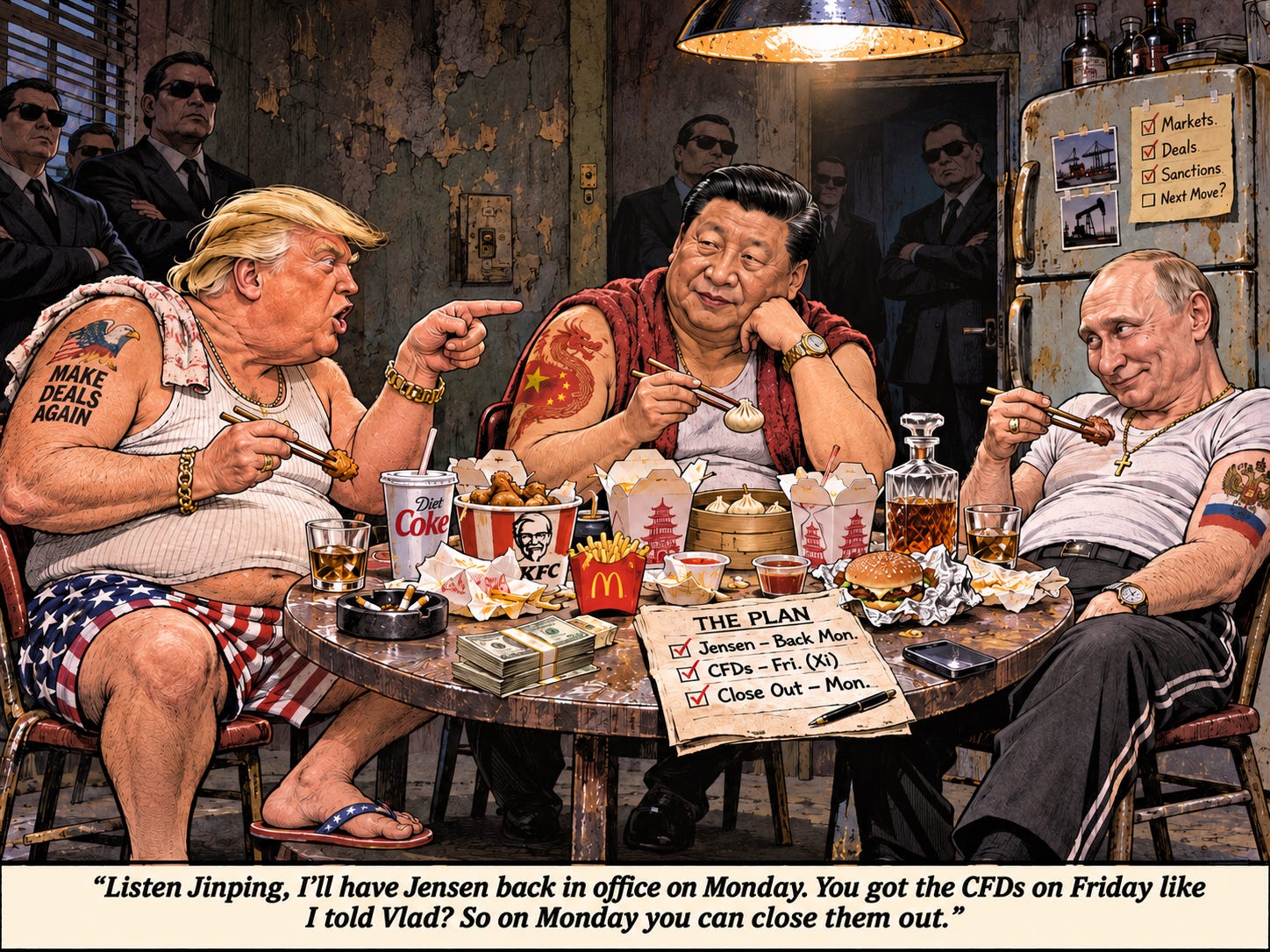
Huang’s departure seemed to be the main cause of last week’s giant sell-off, and today’s reinstatement and share price recovery suggest that at least part of that collapse resulted from an identifiable, temporary shock rather than an emerging systemic financial crisis. That would be reassuring.
Less reassuring is the thought that if the departure of one man can contribute to what might be considered a collapse in market value, and his reinstatement can restore much of it, what does that tell us about the stability of the valuations upon which an increasingly large part of the world’s investment capital now depends?
The Trumpian concept of corporate governance suggests that Nvidia’s board, the American authorities, and others may have influenced decisions with zero accountability or reference to key shareholders. Congressional criticism of the reinstatement suggests that they too have concerns that go rather further than the “Big IT can do no wrong” image that seems to be the Trope de Jour. Perhaps Congress will start asking for the answers to the Unknown Knowns.