
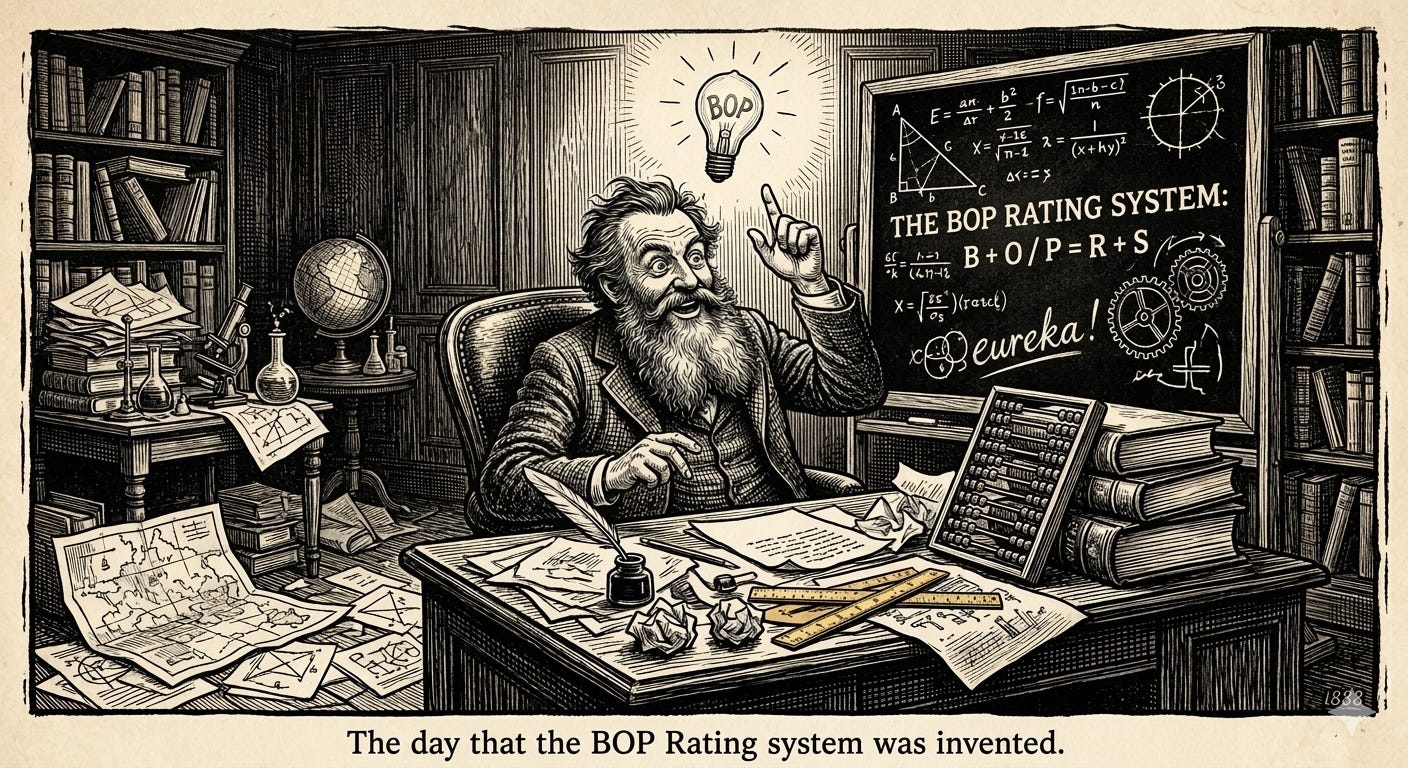
BOP SCORES - How can we now lose at Cheltenham?
A new rating system for the 21st century.
Never having been to University, having failed Maths “O-My-Lord” Level, and having generally worked hard at mastering the use of alcohol as brainfood, it might surprise you to know that I might actually have derived a new set of ratings for horse racing. No, James, stop giggling at the back, it’s true. It is, in very simple terms, a number that tells one how much a horse’s past performance differs from the average of the field. It looks at a huge range of data, from the time spent in the air when jumping, to the time it takes for a horse to get back up to speed on the other side, to the amount of energy left at the finish, and, of course, the impact of the going in historical performances.
I say of course because it makes it sound as though we have already considered all the variations. We haven’t. We’re simply saying, the BOP rating might help in identifying something which is ahead of the pack or, conversely, something which is priced to win, but which will fall out of the back of the TV 200 yards from home.
BOP Ratings for each day will be provided separately throughout Cheltenham week to subscribers, along with our own selections and analysis… Caution, as always, is advised.
The BOP Rating is a high-level analytical engine that distils over 60 distinct data points into a single number. It is designed to ignore “reputation” and focus purely on Energy Efficiency—how much speed a horse generates for every unit of effort expended. It accounts for ground, stride, and price, but uses them as “filters” to determine whether a horse’s physical metrics are sustainable for the specific race.
The four core data sets that comprise the BOP Rating are:
1. The Jumping Economy Module
This is the “DNA” of a National Hunt horse’s performance. We don’t just look at whether a horse clears a fence; we look at the physics of the jump, the three key components:
Speed Recovery Time (SRT): The exact number of seconds it takes to return to cruising speed after landing.
Lengths Gained/Lost: A +/- variance measured against the field median at every single obstacle.
The “Jumping Envelope” (30m In / 30m Out): We track the deceleration on approach and the acceleration on exit. A high BOP horse (like Romeo Coolio) effectively “accelerates” through the air.
2. The Biomechanical (Stride) Module
Stride data is the best predictor of stamina and trip suitability.
Stride Frequency (Cadence): Measured in Strides Per Second (SPS). A lower “minimum cadence” (below 2.13 SPS) indicates a horse operating aerobically.
Stride Length (SL): The distance covered per cycle. In the BOP Rating, we look for SL Consistency. If a horse’s stride shortens significantly on the hill, their BOP score drops, signaling they have “hit the wall.”
Stride Strategy: Does the horse accelerate by turning their legs over faster (Frequency) or by reaching further (Length)? The latter, for example, is much more efficient on Cheltenham’s undulating turf.
3. The “Ground-Truth” Filter
Ground is not a static variable; it is a performance multiplier.
Going Variance: We adjust the Jump Index based on the turf’s “give.” For example, a horse with a 7.5 Index on Heavy ground might see their BOP Rating jump to 8.5 on Good to Soft because their low, fast jumping style is better suited to a firmer landing.
Surface Traction: We track the “slip” or speed loss upon landing. On Good to Soft, horses with a higher Top Speed Surplus get a BOP boost because the ground allows them to use their gears.
4. The “Market-Efficiency” Gap
While the BOP Rating is a “pure” performance score, we overlay the Betting Market to find the value.
Price vs. Probability: If the betting market gives a horse a 10% chance (9/1) but the BOP Rating shows a +2.5 Surplus (indicating a ~25% chance), that horse is flagged as “Overpriced.”
Weight-Adjusted Merit: We take the Official Rating (OR) and the weight carried, then subtract it from the raw speed data. This tells us if a horse is possibly “ahead of the handicapper”—the classic “Plot Horse” scenario.
BOP Rating = (Jumping Variance + FSP Variance) x (Stride Efficiency Filter) ± (Ground Adjuster)
It might well transpire that we have created a number to ensure we lose money faster than the horses can jump - but on the other hand…


