Another rabbit hole with Jerry Maguire, £4.2bn missing in tax and the ongoing success of evil.
And a couple of French and Spanish tips!
Have you ever seen the 1996 movie Jerry Maguire with Tom Cruise, Rene Zeilwegger and Cuba Gooding Jnr? The reason I ask is that it is perhaps the most-quoted film of the 1990s, when all my little reader chicks were probably (I use the term loosely) just leaving school. It is a film full of lines you might not have known emanated from its production. “You had me at hello.” - ”You complete me.” - Help me to help you.” - “Show Me The Money”. My personal favourite, historically used when one is finally made aware that the party is over, is “The f’ing zoo is closed, Ray.”
Just going briefly off-piste, as happens in all rabbit holes, can you name the most quoted film in history, according to AFI? No, not The Godfather or Gone With the Wind… Casablanca. The film has six separate lines featured in the top 100, more than any other film in history. Its lines (and ranking) include “Here’s looking at you, kid” (#5), “Louis, I think this is the beginning of a beautiful friendship” (#20), “Play it, Sam. Play ‘As Time Goes By’” (#28), “Round up the usual suspects” (#32), “We’ll always have Paris” (#43), and “Of all the gin joints in all the towns in all the world, she walks into mine” (#67).
Anyway, the line “Show Me The Money” popped unbidden into my head this morning, as I sipped my cafe creme, waited for the Croissants (b*****r the diet) and sat in the garden with my copy of KPMG’s “Illicit Trade in Tobacco Report.”
In brief, it found that of the 22 billion cigarettes consumed in the UK during 2025, almost a third were counterfeit, contraband, or originated outside the legal market. So let me just say that again.
A third of all cigarettes consumed in the UK are now bought on the black market.
That figure is up by over 15% this year - a near doubling - leading in turn to an estimated £4.3 billion to £4.5 billion in lost tax revenue, driven by organised retail “front” shops and local illegal manufacturing.
HMRC admits it doesn’t really know the true figure, but its best estimate is that it is losing £1.8bn a year, as though that somehow makes it alright. Welcome to the latest trait in Socialist news management: when faced with a large and embarrassing problem, produce a smaller number and call it reassurance.
Talking of shockingly small numbers - the entire UK border force budget is 1.38bn.
The fascinating thing is not really the cigarettes. The fascinating thing is everything that comes attached to them.
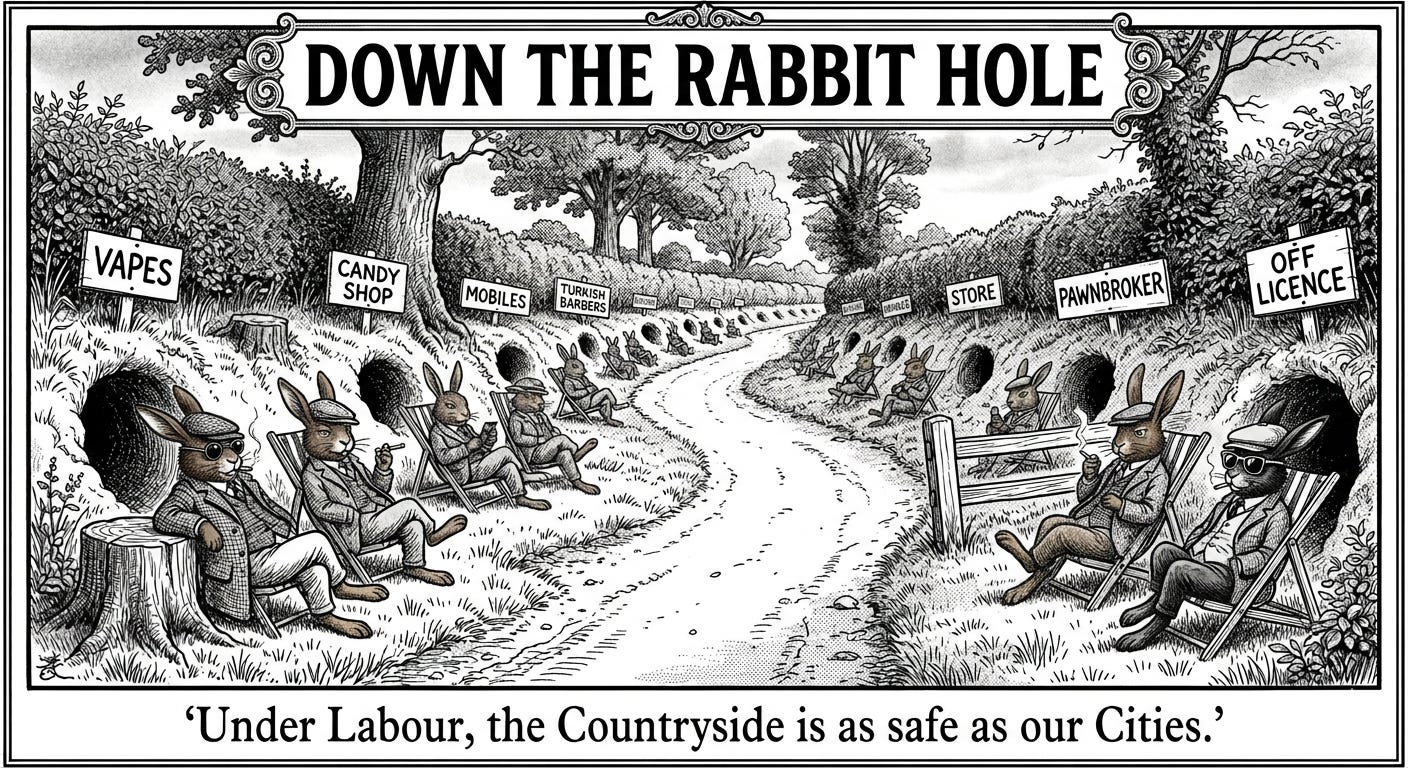
For years, we have been told that these peculiar little shops appearing across towns and cities are simply entrepreneurial success stories. A barber who never cuts any hair. A sweet shop that never seems to sell any sweets. A convenience store where the convenience appears largely confined to organised crime. Don’t make me laugh. The cigarette is merely the commodity. The real product is the infrastructure.
Once you have warehouses, transport routes, cash-handling arrangements, suppliers, distributors, front businesses, and a degree of confidence that enforcement agencies are either overwhelmed, underfunded, or buried beneath seventeen layers of safeguarding guidance and interdepartmental stakeholder engagement, you possess something far more valuable than tobacco sales. You possess a criminal business model.
A man who can move ten million illicit cigarettes from Eastern Europe to Essex can probably find room in the van for a few other things. Counterfeit goods. Drugs. Stolen electronics. Money laundering. Human exploitation. Criminal enterprises rarely specialise out of principle.
The tobacco companies, naturally, have their own explanation. Excessive taxation, they argue, has created a vast price gap between legal and illegal products. Raise the tax high enough and organised crime will inevitably step in to fill the vacuum. There is some truth in that. A packet of cigarettes now costs enough to make a racehorse owner look for a cheaper option.
If the government creates a market in which legal products cost two or three times as much as illegal ones, it should not be astonished when criminal organisations notice the opportunity. Human beings have long displayed a regrettable tendency to respond to incentives, even before the Treasury discovered behavioural economics. But this is where the argument becomes slippery.
High taxes create incentives. They do not create criminal empires. Plenty of countries maintain high tobacco duties without surrendering entire sections of the market to organised gangs. The difference is enforcement. The difference lies in whether the state possesses both the capacity and the will to enforce its own rules.
That is the awkward question lurking behind KPMG’s report and all the other horror stories, such as the criminal rape gangs. Does the British state still have the practical ability to enforce laws that everyone agrees exist? Because once ordinary people become accustomed to buying illegal goods from apparently permanent criminal retailers operating in plain sight, something more corrosive than lost tax revenue begins to take hold.
Respect for the law becomes conditional. Compliance becomes optional. Criminality becomes normalised. And once that happens, cigarettes are the least of your worries. In the old days, these “fake” shops were known as “fronts” because the real operation was hidden from view. Not any more.
Talking of very few green shoots in the High Street…
15:05 Chantilly Prix Diane: GREEN SPIRIT 2 pts e/w - EVITA 1pt e/w
15:45 Chantilly Prix Pawneese: TIFFANY 4 pts Win - SEA POETRY 1½ pts e/w
14:30 Doncaster: BELLA ANGELINA 2 pts e/w
Barcelona GP: LEWIS HAMILTON Win 2 pts 5/1
Barcelona GO: Pierre Gasly Top 6 finish 20/1 2 pt


