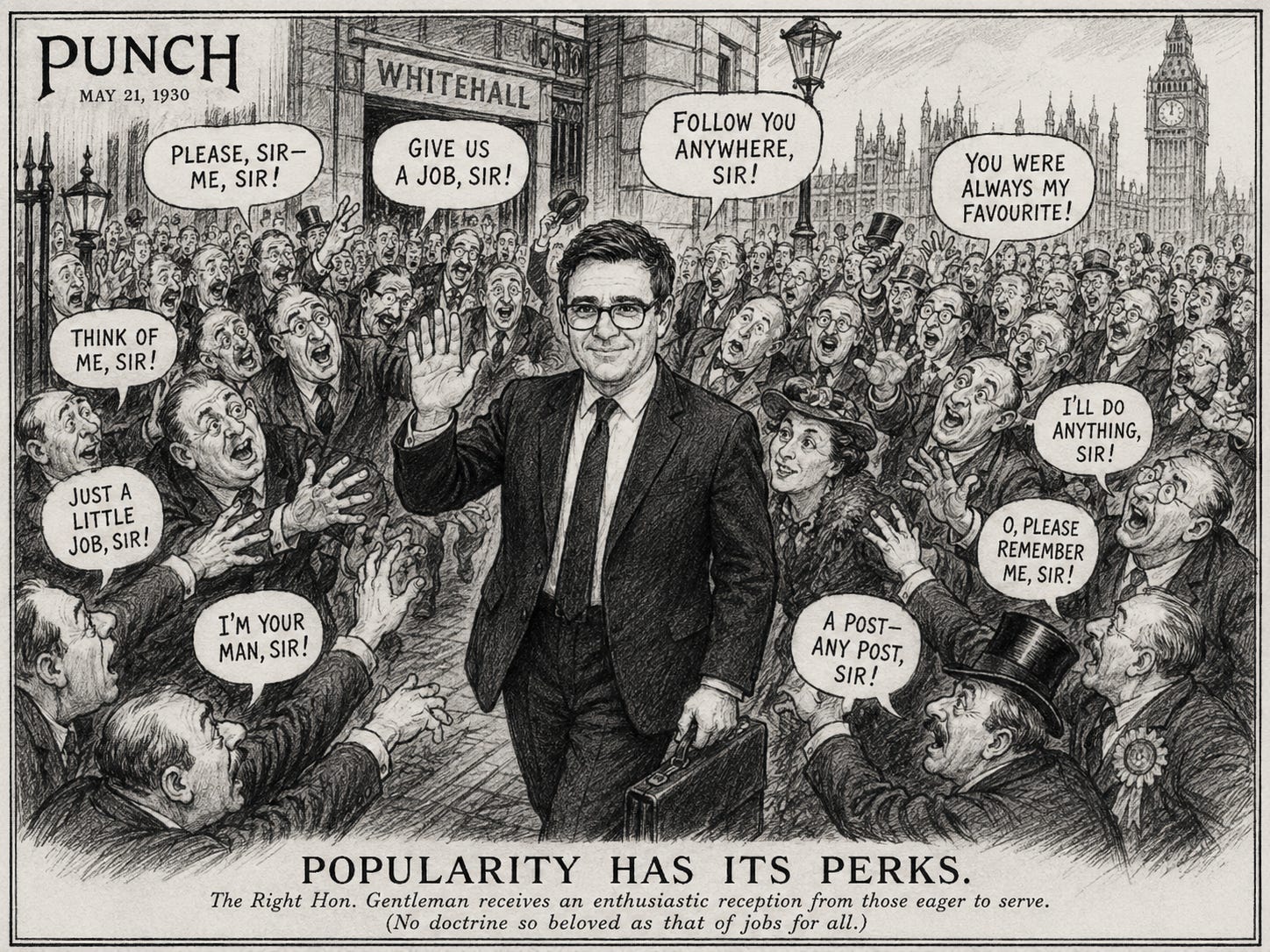
Andy Burnham's first Budget revealed
Thanks to the phenomena of Quantum Time, this recently discovered Telegrpah report of November 26th 2026
THE BUDGET’S FIGURES
What They Mean For You
The Government is banking on voters accepting higher taxes on wealth and greater state intervention if they see lower bills, better services, stronger borders and visible improvements in national capability. Here in tabular form are the key components of Andrew Haldane’s first Budget. Later, we examine the implications, politics, and rationales behind this very unexpected budget.
Total Additional Revenue
£36bn–£40bn per annum
Investors
ISA Holders: No change. Annual ISA allowance retained.
Premium Bonds: No change.
Capital Gains:
Example gain of £100,000: Additional tax liability: £8,000–£12,000
Example gain of £500,000: Additional tax liability: £40,000–£60,000
Dividend Income:
£150,000 Additional tax: £2,500
£250,000 Additional tax: £7,500
£500,000 Additional tax: £20,000
Property Owners
Average Home (£300,000) - Little direct effect.
Family Home (£500,000–£1m) - Generally unaffected.
High-Value Property (£2m+) Potential exposure to:
Council tax revaluation
Land value measures
Future property taxation reforms
Inheritance Tax
Estate Worth £1m: Little change.
Estate Worth £3m: Limited change.
Estate Worth £5m: Additional liability: £150,000–£400,000
Estate Worth £10m: Additional liability: £500,000–£1m+
Smokers
Pack of 20 Cigarettes: +£1.20
Daily Smoker: Additional annual cost: £430–£450
Drinkers
Moderate Wine Drinker: +£40–£70 annually
Regular Pub User: +£80–£150 annually
Heavy Spirits Drinker: +£150–£300 annually
New Defence Manufacturing Jobs
40,000–60,000: Expected in: Lancashire - Barrow - Teesside - South Wales - Clyde
Border Force:
Funding Increase: £4.8bn over five years: Additional Officers 5,000
New Systems: Maritime surveillance; AI monitoring; Customs modernisation;
Intelligence capability
THE NUMBERS THAT MATTER
150,000 - New homes annually
5,000 - Additional Border Force officers
£8bn - Annual NHS and care package
£15bn - Defence industrial programme
£40bn - Annual tax package
£60bn+ - Public investment commitments
£1,000 - Average gain for a £90,000 household
£70,000–£150,000 Average loss for a £1.4m-income household
A Budget that tells us more about Andy Burnham’s ambitions than it does about Labour’s past
For all the inevitable arguments about inheritance tax, cigarette duty and water nationalisation, yesterday’s Budget (Wednesday, November 25th 2026) may ultimately be remembered for something rather different.
It was the first serious attempt by a British government in decades to answer a question that has haunted Westminster ever since the financial crisis:
Why does Britain seem unable to build anything quickly, cheaply or at scale anymore?
The answer offered by Chancellor Andy Haldane was strikingly different from anything heard from either Conservative or Labour governments in recent years. The old Conservative answer was that the government had become too large and too expensive. The traditional Labour answer was that the government had become too small and too underfunded.
Haldane’s answer is that Britain has become too weak.
Not weak in the conventional sense of military decline or national debt, although ministers clearly worry about both. Rather, it is weak in its ability to organise itself. The country struggles to build housing. It struggles to expand energy infrastructure. It struggles to construct transport networks. It struggles to reform social care. It struggles to procure military equipment. It struggles to prevent waste. And it struggles to ensure that public money is used for the purpose Parliament intended.
That diagnosis runs through every major announcement in this Budget.
What ministers are now calling “The Productive State” is essentially an attempt to rebuild state capacity after four decades in which governments increasingly saw themselves as regulators, commissioners and overseers rather than builders, owners and operators.
The significance of Haldane’s appointment as Chancellor should not be underestimated. Unlike most Chancellors, he arrives not from Westminster but from the worlds of economics, banking and productivity research. Throughout his career, he has been fascinated by a deceptively simple question: why do some places, institutions and countries become more productive while others stagnate? Many of the answers he arrived at appear to have found their way directly into this Budget.
The central argument is that Britain has become trapped in a cycle in which the government spends ever-larger sums treating the symptoms of economic failure while investing too little to address its causes. Housing benefit rises because housing is scarce. Energy subsidies rise because energy is expensive. Transport support rises because transport networks are fragmented and inefficient. Social care costs rise because provision remains inadequate. The state finds itself permanently paying for the consequences of dysfunction.
The Chancellor’s answer is not to withdraw from those obligations. It is to intervene earlier.
As one Treasury official put it last night: “We have become very good at paying for failure and remarkably reluctant to invest in success.” That philosophy explains why housing sits at the very centre of the Budget.
For decades, British governments have spoken about housing primarily as a social issue. This Government increasingly treats it as an economic issue. High housing costs restrict labour mobility and reduce disposable incomes, while simultaneously increasing welfare spending. That, in turn, also increases pressure on health services whilst distorting investment and undermining productivity. From that perspective, Haldane and, by implication, Burnham consider building homes to be not merely a social programme but an economic growth strategy. In their eyes, it is one of the few policies capable of simultaneously increasing growth, reducing welfare costs, lowering living expenses and improving social outcomes.
That is why the National Housing Corporation is arguably the most important institution created by yesterday’s Budget.
The same logic applies to transport.
Burnham’s experience in Greater Manchester appears to have had a profound influence on the Government’s thinking. Supporters point to the Bee Network in Greater Manchester as evidence that public control and integrated management can lower costs while improving service quality, although critics note that scaling the model nationally presents obvious challenges. Over the last two months, a raft of Ministers have increasingly come to believe the same principle can be applied elsewhere - but with the essential caveat that the objective is not nationalisation for its own sake. The aim is to lower prices, increase reliability and improve economic performance.
This distinction matters.
Traditional socialism tends to begin with ownership. Burnhamism appears to begin with outcomes. The Government’s question is not whether something should be publicly or privately owned. It is whether the existing model is delivering affordable housing, affordable energy, reliable transport and sustainable growth. Where ministers believe the answer is no, they are increasingly willing to intervene. This explains the water reforms. It explains the expansion of Great British Energy. It explains the regional investment banks. And it explains the creation of publicly backed development corporations.
Yet those expecting a return to the politics of the Labour left may be disappointed.
The Chancellor spent almost as much time discussing waste as he did spending. Indeed, the most politically revealing passages of the Budget concerned fraud, inefficiency and public accountability. The new NHS eligibility verification programme, for example, is less about immigration than it is about legitimacy. Burnham has always appeared unusually sensitive to the importance of public consent. Unlike many politicians who assume voters can simply be educated into agreement, he has generally worked from the opposite assumption: that successful reform requires people to feel the system is fair. Everything in the budget with the NHS tag seemed to have a caveat - but ministers insist the objective is not simply to spend more money but to reduce waiting times, improve access to diagnostics and rebuild public confidence that the NHS remains both universal and sustainable, and above all, to appear as though it does understand it is using public money in the service of the public and is not just a rather grand Not for Profit..
The Treasury’s reasoning is straightforward. Most taxpayers are willing to support a generous NHS. Most taxpayers are willing to support a generous welfare state. Most taxpayers are willing to fund defence. What they increasingly object to is the perception that government does not take stewardship seriously enough. Therefore, the Chancellor’s repeated references to waste, fraud and misuse of public funds served a deeper purpose; it was intended to reassure voters that the state will demand responsibility as well as provide support. One senior Labour figure described the approach as: “Social democracy with an auditor attached.”
The same theme is visible in defence policy. Rather than simply increasing military expenditure, the Government has attempted to connect defence spending with economic renewal. The influence of the war in Ukraine is unmistakable. Officials are talking openly about mass production, resilience, industrial depth and speed. The lesson ministers believe Ukraine has taught is that wars are no longer won solely by the most sophisticated technology. They are won by the side capable of producing enough equipment, adapting quickly enough and sustaining industrial output under pressure. The resulting strategy places less emphasis on prestige projects and more emphasis on drones, autonomous systems, munitions production, battlefield software and industrial capacity. Defence is being treated not simply as a security function but as part of a broader industrial strategy.
The same can be said of border security. The £4.8 billion investment in Border Force reflects recognition that effective border control has become a basic test of governmental competence. Burnham’s political instincts have always been shaped less by ideological purity than by practical legitimacy. His allies understand that no government pursuing an ambitious programme of economic reform can afford to appear indifferent to public concerns about border management, security or fairness. This may be the most important political insight underpinning the entire Budget.
Burnham’s political instinct is also clearly visible in the Chancellor's handling of pensions. The long-rumoured abolition of the Triple Lock, once regarded as politically untouchable, was accompanied by a carefully designed package of concessions aimed at older voters. Additional tax allowances for over-75s, a higher dividend allowance for pensioners, a Winter Energy Guarantee and a commitment to radically simplify probate and estate administration were intended to soften the blow. The calculation appears straightforward. Ministers have concluded that many older voters care less about the mechanics of annual uprating than about preserving their overall standard of living and ensuring that their affairs can be settled quickly and efficiently for their families. It is a characteristically Burnhamite solution: address the fiscal problem, but make sure voters can see what they receive in return.
In many ways, this all feels like a part of some giant economic experiment. Yet the question remains whether those being asked to fund the experiment will accept the bargain. The principal burden falls not on ordinary earners but on owners of capital: investors, landlords, large estates and households deriving substantial income from dividends and capital gains. Ministers clearly believe that such groups are now sufficiently small and that the political benefits of visible public investment are sufficiently large to make the calculation worthwhile.
Additionally, Burnham et al also appear to believe that voters will support substantial state intervention, significant public investment, and even higher taxes on wealth, provided they are convinced that the government is competent, disciplined, and serious. Whether that judgement proves correct remains to be seen.
What is already clear is that yesterday’s Budget marks the emergence of a distinctive new political project. Not Blairism. Not Corbynism. Not Thatcherism. But something closer to a British developmental state: fiscally disciplined, institutionally ambitious, socially democratic, regionally focused and intensely concerned with national capacity.
For the first time in many years, a government is attempting not merely to redistribute prosperity or regulate it, but to build it. Burnham’s wager is that voters will forgive higher taxes, larger institutions and a more interventionist state if they can see homes being built, borders being controlled, hospitals improving, and the economy growing. It is an attractive proposition. The difficulty, as every Prime Minister eventually discovers, is that building things is far harder than announcing them